Linked text is different


Reading (318/365)
cc licensed (BY-NC) flickr photo by Jack Amick
A few years back my friend Bud Hunt published an unusual post on his blog; it was titled Going South. In just a few short sentences he shared that he'd be spending a week visiting his grandfather's garden. "As best as I can determine, the first reference on the Internet to my grandfather, a man that I know far too little about, is this one." he wrote. There was one link in the entire post; the words "this one". You can tell from the comments, not every reader followed the link.


I was talking with a couple of English Language Arts teachers today. They're planning to have their classes do most of their writing online this semester. We were talking about how they might use a Mother Blog model to do that. They'll use Google Reader to monitor the community; subscribing to both the posts and  comments of their students' blogs.


I wanted the two teachers I was talking with understand how to help their students learn to read and write hyperlinked text effectively. I shared with them the story of Bud's "Going South" blog post. It's a poignant lesson in reading and writing linked text. (In the privacy of my own thoughts: This will also be a nice memorial to Bud's granddad. In a way, he'll teach and touch the lives of generations beyond his immediate family.)


A Better Metaphor for Life Long Learning

In his book, Everything Is Miscellaneous, David Weinberger talks about the difference between writing on paper and writing hyperlinked text. Paper has physical limitations that digital text doesn't. It starts and ends. It's only so wide and so long. A paper book can only contain so much content. Even if it's one of many volumes in a larger work.


Have you ever started reading an article online, say in Wikipedia, clicked a link, then another? And another. Only to find yourself two hours later having explored a web of ideas unique to your personal interests along the way. Eventually you stop. Not because you're "finished" but because life imposes other demands on your time.


Digital text is different. It's a much better metaphor for life long learning. And you can't write linked text if you aren't reading. Lots. (It's taken me years of reading to write this blog post.)


New Media, New Process

Not too long ago Dean published a post about writing hyperlinked text. He had collected a number of comments in a storify archive and reshared a video Will had made about his writing process. (Think that through as a writing process.) Watch:


This sort of process is another thing I shared with the teachers I was talking with:


  • Using a mind mapping tool, like mindmeister, that includes hyperlinks is different.

  • Clipping ideas contained in text, images and video using a tool like Evernote, which allows you to create web pages & hyperlinks is different.

  • Writing by stitching your ideas together from hyperlinked sources is different.

  • Reading that text is different too. It matters where you publish it, online or off. Different media (paper or digital) carry different messages. 


I'm fascinated to see the student writing that emerges from this semester.


I'm also curious; is there anything different about how you teach reading and writing digital text? Any advice for us?


UPDATE 20 Feb 2012

Check out Bud's thought provoking digital writing workshop (a network of Google Docs): 

Reading 1.0 - How Digital Changes Nothing. And Everything. Is All.

Linked text is different


Reading (318/365)
cc licensed (BY-NC) flickr photo by Jack Amick
A few years back my friend Bud Hunt published an unusual post on his blog; it was titled Going South. In just a few short sentences he shared that he'd be spending a week visiting his grandfather's garden. "As best as I can determine, the first reference on the Internet to my grandfather, a man that I know far too little about, is this one." he wrote. There was one link in the entire post; the words "this one". You can tell from the comments, not every reader followed the link.


I was talking with a couple of English Language Arts teachers today. They're planning to have their classes do most of their writing online this semester. We were talking about how they might use a Mother Blog model to do that. They'll use Google Reader to monitor the community; subscribing to both the posts and  comments of their students' blogs.


I wanted the two teachers I was talking with understand how to help their students learn to read and write hyperlinked text effectively. I shared with them the story of Bud's "Going South" blog post. It's a poignant lesson in reading and writing linked text. (In the privacy of my own thoughts: This will also be a nice memorial to Bud's granddad. In a way, he'll teach and touch the lives of generations beyond his immediate family.)


A Better Metaphor for Life Long Learning

In his book, Everything Is Miscellaneous, David Weinberger talks about the difference between writing on paper and writing hyperlinked text. Paper has physical limitations that digital text doesn't. It starts and ends. It's only so wide and so long. A paper book can only contain so much content. Even if it's one of many volumes in a larger work.


Have you ever started reading an article online, say in Wikipedia, clicked a link, then another? And another. Only to find yourself two hours later having explored a web of ideas unique to your personal interests along the way. Eventually you stop. Not because you're "finished" but because life imposes other demands on your time.


Digital text is different. It's a much better metaphor for life long learning. And you can't write linked text if you aren't reading. Lots. (It's taken me years of reading to write this blog post.)


New Media, New Process

Not too long ago Dean published a post about writing hyperlinked text. He had collected a number of comments in a storify archive and reshared a video Will had made about his writing process. (Think that through as a writing process.) Watch:


This sort of process is another thing I shared with the teachers I was talking with:


  • Using a mind mapping tool, like mindmeister, that includes hyperlinks is different.

  • Clipping ideas contained in text, images and video using a tool like Evernote, which allows you to create web pages & hyperlinks is different.

  • Writing by stitching your ideas together from hyperlinked sources is different.

  • Reading that text is different too. It matters where you publish it, online or off. Different media (paper or digital) carry different messages. 


I'm fascinated to see the student writing that emerges from this semester.


I'm also curious; is there anything different about how you teach reading and writing digital text? Any advice for us?


UPDATE 20 Feb 2012

Check out Bud's thought provoking digital writing workshop (a network of Google Docs): 

Reading 1.0 - How Digital Changes Nothing. And Everything. Is All.

Teaching (a pedagogical framework)

When I'm asked, in email or face to face, to explain how I use < web based tool > (blogs, wikis, podcasts, what have you) with my students I usually begin by saying: "That's not a short answer." While knowledge of how a particular tool works is important, it's really a distant second to the questions:


What do I have to teach?


and


How can I best help my students learn this?


This is the first in what I hope will be a series that explains how I think about answering those questions.


The slidecast and the videos are best watched in Full Screen mode.


Slidecast


Video


A higher quality video is available via my blip.tv channel.


Audio (8 min 4 sec)


Download 7.4 Mb


Transcript


Years of research into teaching and learning have uncovered some basic fundamental principles of how all people learn. This will just be a quick overview of how I've tried to bridge that research with my practice and what I'm calling a pedagogical framework.


But first an excursion into the world of photography. The photographic technique of framing involves finding something that draws the eye, that sits around an object to draw the viewers' attention to that thing. Here's an example.


The lady is the object of this picture the eye is naturally drawn to see her there in the centre as she's framed by the windows of the subway car.


This is a strong example of framing as we see this man walking through the arches and those arches form a frame. The eye is inexplicably drawn towards the centre of the picture where we see the man.


In this case, a more subtle frame. And yet nonetheless it's clear that the horse is the object of the picture because the tree — which we don't really look at, it kind of sits in the foreground, the eye is really drawn towards the horse — provides a frame to see the horse.


What does this have to do with teaching and learning? Just bear with me.


First the three pedagogical principles, drawn mainly from this book: How People Learn. It was written in ... I believe it was 1999 and then it was updated again in 2000. Studying years and years of research they pulled out three fundamental principles of how people learn. As an outgrowth of that book another one was written called How Students Learn, specifically in the areas of History, Mathematics, and Science. These books have been absolutely seminal in forming my thinking and providing the pedagogical framework around which I structure all the teaching that I've done.


Typically when kids come to school they think of the world as flat. They have no reason to think of it as round and they come to school and we tell them the world is round. What studies have shown is that once kids leave school and they're asked to explain what they've learned: "Well the world is round." And their conception of the world is that it's a giant pancake. That's an interesting preconception that kids bring with them when they come to the classroom and teachers need to know that. Because the first principle out of the book is that "students errors and misconceptions based on previous learning" are the first thing that teachers have to try to connect with when they're trying to teach new content.


In this example, one drawn from mathematics, kids are often taught that multiplying is repeated addition. Multiplying is not repeated addition (although that's a good place to start) and they think that the answer to any question, when they multiply, has to be bigger than any of the numbers they started off with. Given a problem like this, fractions, well kids find that really hard, they just mul... they see the two the three and they know they have to have an answer that's bigger than either of them. If we know that that's the preconception that kids bring to the classroom then that can inform our teaching in constructive ways.


The second principle out of the book is that understanding requires not only factual knowledge, knowledge of basic facts, but an understanding of the basic ideas or big ideas of the discipline, whatever the discipline is that happens to be that you're teaching. Because knowledge isn't actually built in hierarchies knowledge is actually built in networks. For example, take something simple like three quarters. It seems like a pretty simple idea. But the number three quarters can be represented in a variety of ways. All of these are equivalent ways to write three quarters. It might have meant money, seventy five percent, it could be the ratio of three to four, point seven five or another way to write the fraction three quarters. Now even this extends beyond that because, "three quarters", well I could have been saying the money, three coins, three twenty five cent coins, which is seventy five cents. You see all these ideas are connected one to the other.


I might have been talking about a piece of cake; that I have three quarters of a cake. And it's implicit in that idea that each of those quarters is the same size. That each piece of cake has to be equivalent in size. But that's not always true with all ratios.


For example the ration of three red Smarties to four blue Smarties. I've got seven Smarties in total. And those Smarties don't all have to be the same size for my ratio of three red to four blue to be true.


These implicit assumptions make learning this material difficult for kids, and we as teachers make assumptions because we understand from the context that these things are clear. It could be seventy five percent off everything. That these ... All of these ideas actually live a network all one related to the other. The underlying assumptions that we make as experienced learners is that we take, from the surrounding context, what the meaning of each of these numbers is. And yet each one is related to the other.


That network has to be made explicit. That network of concepts has to made explicit to students. No matter what fundamental idea you're trying to get across to the students. In this case, the idea, the big idea, is really one of proportion.


The third principle out of the book is that "learning is facilitated through the use of meta-cognitive strategies". The degree to which we can get kids to think about what they're learning as they're learning it will deepen that learning. And they found that this made only moderate increases for high performing students, but for low performing students the use of meta-cognitive strategies made for dramatic increases in their performance.


Error analysis is a great example of this kind of thing; you've probably caught that one really quick. But as you look at this picture and try to find the error look how you're thinking about it. Look how you're paying attention to certain details; finding what's the same, what looks exactly identical? Where is the difference? Where is the thing that stands out one different from the other? And if you pause to reflect even as you're thinking about this now you'll notice that you've deepened your own thought as you look for the error in just something simple, like a picture of three Mounties.


So that's the framework. That's the framing. That's the ... Those are the ideas that sit around any pedagogical approach that you want to take in class. Any time you want to structure or design a learning experience for students these three principles:


Connect with kids preconceptions.


Learning should be networked. Ideas are networked. You need to understand basic facts but also the big ideas around which knowledge is structured.


And engaging kids in meta-cognition as they're learning.


This provides the framework for how we teach.


There's one last thing not to exclude in any of this and that's "community". It's alluded to in that book but not listed as one of the fundamental principles; but "community" is a pretty big deal. Because the degree to which we can get kids working with each other and collaborating and helping each other in their learning, which is what genuine learning looks like, is the degree to which they can deepen and accelerate their own learning.


This provides a wonderful example of exactly what I'm talking about: Why do geese fly in this "V" shape? It seems quite distinctive to see the Canadian geese flying in that pattern. It happens in the Fall, around October, and then again in the month of March as when ... as the geese leave in October and return in March. Why the "V" pattern? Because the flapping of the wings of the lead goose actually provides a little lift for the geese just behind them. And that's true for each goose behind every other goose. And so they're able to fly greater distances. Of course this puts undue pressure on the lead goose. So throughout the flight the geese are constantly shifting positions and rotating their spot in the "V" shape flight pattern. So that different geese take the lead at different times. And by working together the geese are able to fly for much greater distances than any of them would be able to fly on their own. And together they accomplish great things which is the very distant migration patterns of the Canada geese. Of course over short distances, if everybody goes their own way, well, yeah, you could have some success, and when they all land that's what it looks like. And they all kind of come down and each one chooses their own pattern and the "V" is broken up. And occasionally, you know, you need to do that, but by and large, for the most part, it's through that collaboration that great things become possible. And that's part of that framework that I talked about.


It's just like we learned in kindergarten: When you go out into the world, hold hands and stick together.


Teaching Interdependence

... was the title of the Keynote address I gave to 500+ educators at this year's B.Y.T.E. conference. The sense I had of the audience was that many of the ideas I talked about here were new to them. A quick survey of the room while giving the talk revealed only about three people had heard of Wolfram Alpha and I think about the same number had heard of the TPACK Framework.


I hope I get a chance to do this talk again. There are a number of things I think I could have done better.


Anyway, if you're interested, here it is in various formats. You pick how you'd like to take it in.


Audio


Download (20 MB)


Slidecast


Ustream Video (thanks to Chris Harbeck


I've Got 5 Minutes

actually, it was 11 minutes and 45 seconds.


This is the slidecast from one of three talks I gave on Friday October 9, 2009. I was in Virden Manitoba participating in the NIBBLE Conference for the Fort La Bosse School Division.


More coming soon. Everything will be aggregated on the Senior Years Information and Communication Technology wiki I'm maintaining to share all the work I do in Manitoba with teachers across the province ... and you.


The Ten Commandments

From the archives ... I started writing this post in November of 2007.


A LONG TIME COMING


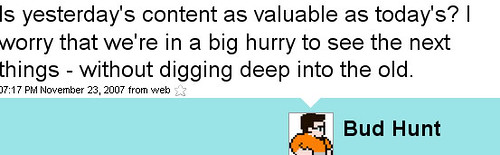
A while back, Dean and Bud got me thinking. Bud's tweet contains more than a kernel of truth.


Shortly after reading Bud and Dean I was listening to David Suzuki on the radio. He mentioned in passing the idea of "in depth news reports" on television. Generally, that means they're going to talk about an issue for about two minutes. Some issues need to be explored in more depth than that. I think pedagogy is one of those issues. In particular, I think I need to explore my own teaching, articulate my own pedagogical practices, open them up to scrutiny and shore up the weak bits.


George Polya's ideas have been very influential on me and my evolution as an educator. Since reading his Ten Commandments For Teachers I have tried to model them in my practice. Although Polya (1887-1985) is no longer alive, I consider myself one of his students. This series of blog posts is my record of what I'm learning about the craft of teaching.


IN BROAD STROKES


In chapter 14 of Polya's book, Mathematical Discovery, he talks about the teacher's attitude and structures his thinking around what he calls The Ten Commandments For Teachers. This is the first in a series of posts digging into this in depth; maybe four, maybe ten; one for each commandment. We'll see.


Although I've been thinking about it for a long time, I've got more questions than answers about these commandments. I want to share my thinking and questions here because:


(1) I want to capture my where my thinking is at today so I can come back and reconsider it in the future.


(2) I'm hoping people wiser than I might share some of their insights. I'm hoping the give and take inherent in blogging about it might push my thinking and practice; make me a better teacher.


So push back at any weak bits below or share your own teaching tip.


THE TEN COMMANDMENTS FOR TEACHERS


In chapter 14 of Mathematical Discovery Polya lists his Ten Commandments For Teachers. They have been a guiding light for me as a teacher since I first read them.


1. Be interested in your subject.


2. Know your subject.


3. Know about the ways of learning: The best way to learn anything is to discover it by yourself.


4. Try to read the faces of your students, try to see their expectations and difficulties, put yourself in their place.


5. Give them not only information, but "know-how," attitudes of mind, the habit of methodical work.


6. Let them learn guessing.


7. Let them learn proving.


8. Look out for such features of the problem at hand as may be useful in solving the problems to come — try to disclose the general pattern that lies behind the present concrete situation.


9. Do not give away your whole secret at once — let the students guess before you tell it — let them find out by themselves as much as is feasible.


10. Suggest it, do not force it down their throats.


MODELING PASSION: Be Interested In Your Subject


Polya identifies the single most powerful and infallible teaching method: "If the teacher is bored by what he is teaching it is a certainty that all his students will be too." I believe the inverse is also true: If a teacher is interested in what they are teaching their students will be too. Actually, "interest" by itself may not be enough; passion is a virus. There is a contagion in passion that can be passed on. I would rewrite Polya's first commandment as: "Be passionate about your subject." If you can't do that then I guess interest will have to do but if you don't have even that, do something else.


If you were a student in grade 8, and your teacher began a new unit of study like this what do you think your engagement with the material might be? Passion Based Learning is powerful stuff. There's something magnetic about a teacher who is passionate about what they are teaching. Passion leads to Interest leads to Life Long Learning. Kids need to see that their teachers are interested with their subject and constantly trying to get better at what they do. If we don't model the drive for excellence in what we teach why should they be interested in doing excellent work in our classes?


The teacher's most powerful pedagogical tool in their toolbox is tucked away in their attitude, demeanor and engagement with what they are teaching; we call it modeling. It's such a fundamental idea. Surprisingly, some quick searching on the net reveals very little written about the importance of modeling in education as a general pedagogical practice. Even wikipedia has very little to say about it; the closest article to this idea is called Modelling (psychology). It seems to me we need a few good educators to flesh this article out a bit on wikipedia.


A while back Dean asked, Can A Fat Man Teach Phys. Ed.? His answer: "Yes, but ..." It all comes back to the importance of modeling.


I'm reminded of Benjamin Zander who says:


Our job is to awaken possibility in others ... You know you're doing it when their eyes are shining. And if their eyes are not shinning, then we have to ask ourselves, "Who am I being that my [students] eyes are not shinning?"


Rick Van Eck: Games as Innovative Teaching Keynote

I've had this sitting in draft for about 7 months. It goes all the back to the end of May when I had the good fortune to attend the Microsoft Innovative Teachers Conference held here in Winnipeg. The line up of speakers was excellent, but Rick Van Eck stood out as the highlight of the entire conference for me. (I blogged about Rick's Breakout session at the time.) He has a very down to earth, practical, honest approach to using COTS (Commercial Off The Shelf) games in education. Unfortunately the question period isn't included. Rick really shined during the Q&A afterward where his direct, honest, polite replies to pointed questions impressed everyone.


Anyway, I've mentioned this talk several times in passing since I saw it and now I can point people to hear the man himself. It's short; 22 min 21 sec. Worth every minute. You can click through Rick's slides below the video as he speaks.


(Download mp3, 25.4 MB)


Slides:


How Flickr Threw a Switch In My Head

Last year, one of the people in my aggregator, D'Arcy Norman, published a video to share the results of his year long experiment: he took a picture every day for a year and published it to his flickr account. He called the experiment 365 Photos. Actually, an entire community has grown up around this idea on flickr; it wasn't D'Arcy's idea originally, there are over 1200 "365 Days" groups. I don't know who started this originally but it seems like a natural extension of publicly sharing your photos.


D'Arcy said a switch got thrown in his head. Watch his video of the results; as you watch you'll get a sense of what his year was like, when and where he went on vacation, his love for his son, the things he finds interesting, but pay particular attention to how he uses perspective, how sets up his "shots", and the things in his world he notices:


As the new year rang in for 2008 several other people in my aggregator decided to join D'Arcy in his new experiment: 366 Photos (2008 is a leap year). After several weeks many started writing about how their visual perception changed as a result of doing this. They started noticing things they hadn't before, the quality of the photos they took (of things, family, friends, events, etc.) improved dramatically, and a switch in their heads flickred.


I came late to this party for a number of reasons, not the least of which is that the "every day for a year" commitment intimidates me. So, in March I started my own experiment: 31 Days.


There's a bit of folk wisdom that says it variously takes 21 or 28 days to create (or break) a habit. (15 minutes a day every day. If you miss a day just keep going until you get to 21 — or 28 — days in a row.) I've been able to find no verifiable research to back this up so make of it what you will. In any case, I did find that my 31 Days experiment lead to a change in the way I see the world and use visual imagery in my teaching.


Now, this part wasn't planned, but as I've used flickr more and more I've become more and more interested in taking "interesting" pictures.


As a math teacher I was fascinated to discover that photographers have long known of and used a mathematical definition for beauty. It's based on the number φ, phi (one H of a lot cooler than π, as my students say), which it turns out is embedded in the the natural world in all sorts of ways including the various dimensions of our own bodies. I digress, that's a post for another time. ;-)


I stumbled upon an online photography course over at morgueFile.com. I've only read through Lesson 1: Composition And Impact - It's A Beautiful Photograph, But Do You Know WHY It's Beautiful?. It had a significant impact on how I take pictures and view the world. That was almost a year ago. I'm about ready to move on to Lesson 2: Aperture And Shutter Speed - How They Work Together.


Here's how I did my 31 Days experiment:


 » All pictures were taken with my cell phone. (Because it's always there, and it's easy.)


 » All pictures were uploaded to flickr (almost) daily. (You can send directly from your phone if you like.)


 » All pictures were tagged with a unique tag for the experiment. i.e. 31Days.


 » All pictures were aggregated on my blog using a slideshow tool, SlideFlickr.com (also allows you to embed music).


 » I took at least one picture every day. (Some days I took more and picked the one liked best.)


You might wonder: Why all this photography stuff from a math teacher? Well, the short answer is that I wanted to model what I asked my students to do — check out the flickr assignment I designed.


The long answer is: It has enriched my life. I used to leave taking pictures to others; my wife or mother-in-law. Now I take more pictures than anyone, and the skills I've developed have lead to some striking pictures of my kids (sorry, we don't publish publics pics of our kids online ... yet). More than that, it has effected the way I read to learn. I recently finished reading John Dewey's Experience and Education. I decided, as a mnemonic and a way to help me move everything I read into long term memory swiftly, I would mentally construct an image that summarizes the content of each chapter. I hope to publish it as a slidecast (slideshow + podcast) on Slideshare in the near future. I know that little book really well as a result of doing this. Creating the slidecast will really embed it in my brain.


Anyway, I think I'm ready to try this experiment again in October. October in Winnipeg starts with colourful leaves on the trees and ends with snow on the ground. This is going to be fun!


Photo Credits:


Me and my Cell by flickr user dkuropatwa


Vitruvian Genesis by flickr user karlequin

Les Foltos: Brainstorm and Wrap Up


This is the closing keynote presentation given by Les Foltos, Director of the Puget Sound Center for Teacher Learning and Technology, at the Microsoft Innovative Educators Conference held in Winnipeg on May 29, 2008. (The site appears to be down, or broken, now. I thought it was supposed to serve as a commons around which a growing network of teachers was going to built. I wonder what happened?)


This is the last podcast from the from the conference I recorded. It's a little noisy to listen to. We were all talking in small groups trying to crystallize what we had learned over the previous two days. The good news is we talked about many of the same things that we had discussed in the previous day's Ustream. The voices you hear talking in our little group are me, Clarence Fisher, Chris Harbeck, John Evans, Andy McKiel, Kathy Cassidy, and another lady whose name, unfortunately, I've forgotten. She was sitting in a neighbouring group and kept looking over at us, interested in what we were talking about. So, I invited her over and I'm glad she joined us. I think we all got a lot out of this conversation. Give it a listen and add your own two cents in the comments below.


(Download File 30.0Mb, 62 min. 30 sec.)


UPDATE


Great news! Chris found the Ustream recording!! Good on ya Chris. ;-)


Watcher beware: a surprising amount of time is devoted to discussing Dean Shareski's eating habits and his coffee mug — we had a lot of laughs. ;-)


Time: 36 min. 13 sec.


Live Videos provided by Ustream.TV

Richard Van Eck: Games Based Learning Breakout Session


This is the audio from Richard Van Eck's breakout session at the Microsoft Innovative Educators Conference. It's full of very practical ideas for how to incorporate using commercial off-the-shelf (COTS) games in teaching a variety of subjects in the K-12 curriculum. Rick's presentations are very grounded with very little flash in his slides but lots of good concrete ideas to take back to the classroom. The night before this session Rick gave a keynote presentation on games based learning. He was asked if the kind of learning kids do in games based learning transfers well to the content areas. He looked the questioner straight in the eye and said, loudly and clearly: No. Then he fleshed out that answer. I still might be able to track down the audio from the keynote. If I can get it I'll publish it here. In the mean time this is a very practical talk about how to begin using COTS games in your classroom.


At about 19 minutes in Rick tried to get online but was locked out. Thankfully, Chris Harbeck was there and had the password. ;-)


(Download File 14.6Mb, 30 min. 30 sec.)


Photo Credit: Richard Van Eck by flickr user cogdog

Teaching to the Brain


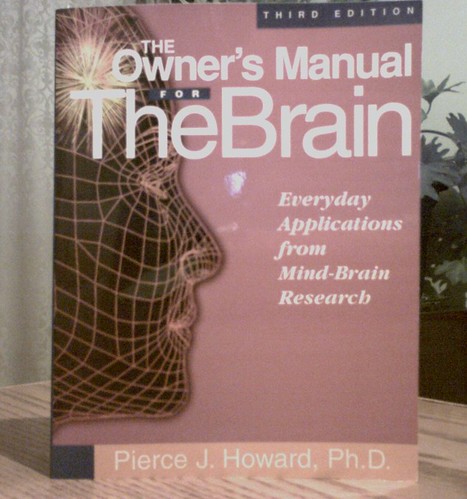
I've long held a ravenous appetite for learning how the brain works and how those capacities can be leveraged to help kids (and me) learn. I recently bought the owners manual. A few days back Jeff Utecht tweeted about a Google Talk by John Medina, authour of the book Brain Rules. John is blogging and sharing some great stuff.


Garr Renolds adapted some of the Brain Rules for presentations. As I've blogged earlier presenting information is something teachers do every day and we need to learn a lot more about how to do it more effectively. So, for my own future reference, and yours if you like, here is John Medina's Google talk, Garr's presentation, and a seemingly unrelated presentation by Dean Shareski whose K12 Online presentation on Design Matters continues to push my thinking every day. Look at how this presentation of Dean's adheres to many of John Medina's Brain Rules; and Dean hasn't even read John's book yet.


In future posts I hope to share how what I'm learning from all this is making it's way into my classroom. I'd love to hear how others incorporate these ideas into their work as well; in education or elsewhere. When we share these ideas and applications, whether they work or not, it helps us all learn.


UPDATE


Dean referenced this video at the end of his presentation; it's well wortht the 4 minute look:


Student Voices Episode 3: Chris, Craig, and Graeme


In this episode of Student Voices three Advanced Placement Calculus students, Chris, Craig, and Graeme, talk about a wiki assignment they did to prepare for the exam. Then the conversation transitions to a discussion of the many things they learned while doing their Developing Expert Voices project. It ends with a challenge, the result of which will be featured in a future podcast.


You can find their project on this year'sDeveloping Expert Voices blog or scattered across YouTube; it's called DEV: Watch and Learn; soon to be aggregated on the project blog.


Let Chris, Craig, and Graeme know what you thought about the podcast by leaving a comment here on this post or on the mirror of this post on their class blog.


(Download File 31.8Mb, 26 min. 30 sec.)


The video mentioned near the end of the podcast is called Daft Hands. Here it is:


Photo Credit: Shadow singer by flickr user EugeniusD80

Things They Should Have Taught Me

Today I swung a meter stick around the classroom like a samurai sword. I called it: "My great and mighty swuhord!" It's become my standard opening for the unit on conic sections which we'll be studying in grade 12 pre-cal for the next week or so. This is followed by playing with paper; folding it to create a parabola according to the locus definition — but I don't tell them that's what we're doing right away. Here are the slides from the class:


As I swung the swuor ... meter stick, I spoke Japanese with a feigned accent: "Kawasaki, Susuki, Honda! Sony Mitsubishi!" (Yeah yeah, they're not all Japanese. I know.) My lips kept moving soundlessly after I finished speaking. We we're rolling on the floor laughing. We had to stop for a laugh break. Talking straight faced about mathematics, my lips continued moving for a few seconds after I spoke throughout the rest of the class.


Here's the thing though, when I started talking about the connections between the geometry and the algebra behind parabolas I had their complete attention. They followed every step of the way. Even those that don't usually pick things up quickly the first time picked it up fairly quickly when it was reexplained.


I've always tried to use some humour in my classroom, but reading an article about two years ago really inspired me to try to inject even more humour in my teaching. It's called USING HUMOR IN THE COLLEGE CLASSROOM TO ENHANCE TEACHING EFFECTIVENESS IN "DREAD COURSES". This is part of a larger course for college instructors on how to be better teachers.


Why don't they teach this stuff to pre-service K12 teachers? Why didn't anyone teach me this stuff before I walked into the classroom? There's certainly plenty of research out there supporting the use of humour to enhance teaching and learning. For example, this article from the Journal of Statistics Education Using Humor in the Introductory Statistics Course was written almost six years ago. From the article:


  • • Humor Builds Relationships and Enhances Communication


    When students talk in class (I'm going to use this one!): “What! I hear voices again. My psychiatrist told me that if I keep taking my Prozac the voices will go away.”


  • • Humor is a Stress-Reducing Tool (preparing for tests)


    If you make certain very egregious errors (for example, a negative probability), not only will you not get partial credit, but we will somehow manage to take points off of exams you are taking in other subjects. We might even take away points from courses taken in high school. In fact, one day, when your children and grandchildren are taking my class, we will take away points from their exams too! Alternatively, “Give me a probability greater than one and I will take away your car.”


  • • Humor Makes a Course More Interesting


    "Education is the only paid-for commodity regarding which, the less you provide, the happier the customer."


  • • Humor Enhances Recall of Information


    Years - some would say days - from now, students will have forgotten much of what we teach them. But they remember the humorous methods used to illustrate important points.


This is probably my favourite joke in the article:


A statistics major was completely hung over the day of his final exam. It was a true/false test, so he decided to flip a coin for the answers. The statistics professor watched the student the entire two hours as he was flipping the coin ... writing the answer ... flipping the coin ... writing the answer. At the end of the two hours, everyone else had finished the exam and left the room except for that lone student. The professor walked over and said, "Listen, I see that you did not study for this statistics test, you didn't even look at the exam questions. If you are just flipping a coin for your answers, what in the world is taking you so long?" Still flipping the coin, the student replied "Shhh! I am checking my answers!"


Humour relaxes us and helps us think better. Shouldn't something like that be a part of every curriculum and instruction class?


And speaking of Things They Should Have Taught In The Faculty Of Education, what about presentation skills? Stuff like how to use your voice, organize text and images to convey ideas, how to "work a room". Shouldn't this also be taught in Faculties of Education? Teachers are "on stage" every day, several times a day, presenting content and "working the room" to help kids learn. This seems like such a "no brainer". Does any Faculty of Education anywhere specifically teach presentation skills in the way the teacher in this video or this one (from teachers.tv in the UK) gets that help when he tried to go "From Good to Outstanding?"


In the last several years I've given a number of presentations to many different audiences. The skills I've developed have spilled over into the classroom. Compare how I taught this class last year:


to how I taught it this year:


The image in that last slideshow introduces what I think is another powerful teaching practice: metaphorical thinking. A binomial distribution is displayed graphically as a sort of bar graph called a histogram (the dogs are lined up in a way that is reminiscent of a histogram). Also, an experiment is binomial if and only if it has exactly two outcomes, typically described as "success" and "failure". Do you see this characteristic displayed in the image? My students did. But that's a post for another time.

Assessment and Rote Learning

David Truss has a great post called Assessment & Rote Learning: Math Conundrums. I tried to leave a comment. I discovered I'm passionate about what Dave had to say. The blog, or my cocomment plugin, borked (yes, that's a technical term) and wouldn't let me leave the comment so I decided to share it here. You may like to read Dave's post before continuing with this.


Breathtaking post, or was it three? ;-)


Assessment


I did the same exercise with my dept. We also had the same vastly differing results you did. At a provincial in-service about 9 or 10 years back I participated in the same exercise using real student generated work. Results varied from around 33% to 80%. This is one facet of Academe's Dirty Little Secret. Anyway, in my dept. we've been looking at how we assess all the content in all the courses we teach; one course at a time, one unit at a time. We're trying to develop a consistent approach to assessment at least within our building. We'll be "at it" for a while yet.


Basic Skills


Fluent knowledge and recall of basic addition, subtraction, multiplication and division facts are essential for ANY student to experience success in math. I'm on the same page you are Dave.


A grade 9 student, who struggles (mightily) with her multiplication facts, and I were talking about this last week. As I was trying to help her I asked why she thinks I feel it so important for her to become fluent in her recall of the multiplication table:


"I know, I know, some day I might not have a calculator and I might need to multiply two numbers."


[Oy! Who tells kids this stuff? And do they really believe that? -- I mean the adults, not the kids. I know the kids don't believe that.]


"No. That's not why. You'll always be able to get a calculator if you need to multiply a bunch of numbers. That's not the reason. It's that you need to know the language of math so you can join the conversation."


"If your teacher is trying to teach you why multiplying pairs of negative numbers always have a positive result, or why, when we divide fractions, we 'multiply by the reciprocal' they're going to talk about stuff like 7x8 and assume you know it's 56 and go on to discuss some deeper ideas. If you're hung up on 7x8, need to pull out a calculator, you're going to miss the entire conversation. Your brain will be back 5 steps while everyone else is talking about this other stuff. By the time you figure out what's going on you won't know what's going on. You'll feel lost and confused and fall farther behind."


"Why do I need to know math anyway?"


"For the same reason you need to know how to read. Because it's a fundamental way that humans communicate with each other and understand the world around them. If you can read but you can't understand mathematics then there will be giant tracts of things happening in the world around you that you'll never understand."


[Whew! Went on a bit of a rant there. I'm going to get a cup of tea ... Cheers Dave!]


Photo Credit: Conundrum by flickr user wyld stallyn

Plain and Simple: They're Wrong


A study was released about 5 days ago. The title: The Advantage of Abstract Examples in Learning Math. A number of articles about it share the title" Concrete examples don't help students learn math, study finds. (Supporting material can be downloaded as a pdf here.)


From the article:


Teachers often use real-world examples in math class, the researchers said. In some classrooms, for example, teachers may explain probability by pulling a marble out of a bag of red and blue marbles and determining how likely it will be one color or the other.


But students may learn better if teachers explain the concept as the probability of choosing one of n things from a larger set of m things, Kaminski said.


If Ms. Kaminski (one of the authours of the study) tried this in any high school classroom she'd bang up hard against a confused wall of silence from all except the most gifted students.


About 2500 years ago Aristotle wrote about how presenting an argument from the general to the specific (deduction) is only one of two forms of presenting information (teaching). Arguing from the specific to the general (induction) is the other. Both have their place.


Anyone who has taught mathematics in a high school classroom knows kids really need to learn and understand both. Often, they just can't grasp general concepts until they have seen several concrete examples. This is what Aristotle calls induction. It is a weaker form of argument than deduction (arguing from general principles to specifics) but is a necessary step in the learning process. Generally speaking, kids find inductive arguments far more compelling than deductive ones, even though the reasoning behind deductive arguments is far more sound.


One of the authours of the study also said:


Story problems could be an incredible instrument for testing what was learned. But they are bad instruments for teaching.


Sometimes a study is just plain wrong. This one is just plain wrong. "Story problems" are excellent tools for both teaching and learning, particularly when students are taught to recognize the underlying patterns of the general mathematical ideas they contain. I find teaching mathematics is something of a dance; constantly flipping back and forth between induction and deduction and guiding students through the process of teasing out the underlying patterns that tie several problems together; problems that on the face of it seem to be quite different are in fact the same ideas in different clothing.


In general, mathematics is the science of patterns. It is the job of the classroom teacher to help students recognize and identify those patterns so they can use them to solve many different problems as they come to recognize the connections between seemingly disparate situations.


I wonder too about the methodology of the study. The article says: "students were taught artificial mathematics". It seems possible (likely?) that the results were skewed as a result of the interference effect.


Dean Shareski tweeted that these results might take root. It made me think of the controversy surrounding The Learning Pyramid. I hope Dean's concerns don't materialize. From teaching hundreds (thousands?) of students over many years I know this study is just plain wrong.


Photo Credits: Wrong on the internets by flickr user mindcaster


Wrong by flickr user Happy Dave

Student Voices Episode 2: Tim_MATH_y


In this episode Timothy, a grade 12 AP Calculus student, comes back to high school on a Friday afternoon to talk about his week attending the miniUniversity program at the University of Winnipeg. He talks about the differences he finds between teaching and learning at high school and university and describes learning in the university classroom using a thought provoking metaphor, listen for it. Also, we have a cameo appearance by two very special people at the very end.


Please feel free to leave Tim_MATH_y your comments here or on this post on her class blog. You can find the archive of his most recent online work in his class blog.


(Download File 7.2Mb, 15 min. 3 sec.)


Photo Credit: Shadow singer by flickr user EugeniusD80

Student Voices Episode 1: Jessie


I was talking to one of my students earlier this week while helping her review over the lunch hour. I found her comments so compelling I asked her (and later her parents) if I could record and publish her comments so other students could hear what she had to say. I've long thought students need to hear from other students how they best learn to help them all learn.


This is the first in what I hope will be a series of podcasts called Student Voices. I'm hoping to have one of these short conversations with a student published each week.


I was inspired by the powerful presentations done by my students on Monday at the Pan-Canadian Interactive Literacy Forum. Hearing how students talk powerful learning experiences in their own words fascinates me; I find it very compelling when I begin to doubt if "all this web 2.0 stuff" is worth mine and my students efforts. Listening to Jessie talk gave me a shot in the arm at a time when I really needed it.


In this episode Jessie, a grade 12 Applied Math student, shares how she uses her class blog to learn and describes her personal "tipping point" from being confused to understanding the class material very well. She also discusses the value of learning conversations and how sometimes being a "teacher" and sometimes a student helps her learn.


Please feel free to leave Jessie your comments here or on this post on her class blog. You can also find the archive of her most recent online work in her class blog.


(Download File 5.6Mb, 11 min. 40 sec.)


UPDATE


I cross posted this to all my class blogs. I'm thinking this might be a way to help build community between them and encourage cross commenting by students.


Photo Credit: Kids of conversation by flickr user Kris Hoet

Students Rock! the Pan Canadian Literacy Forum

Chris and I were invited by Cheryl Prokopanko, along with six of our students, to participate in a panel presentation at Canada's first Pan-Canadian Interactive Literacy Forum.


Preparing for today led to a collaboration that involved introducing my students to Box.net, where we shared our evolving presentation slide decks in a space where we shared access, and several skype calls with Chris.


Cheryl opened the presentation with an overview of Manitoba's new Literacy in ICT curriculum continuum which has evolved over the last several years (next year is the first year implementation is required by all schools in the province). It began with this video ...


Then Cheryl introduced Chris and I and our students. Chris and I bookended the kids presentations. Chris made some opening remarks, I made some closing remarks (actually, it was an invitation). But the highlight of the entire event was the kids. They so rock! Watch and see ...


... and it continues with my students, then me, here ...


We ended off with a question and answer session (Podcast: 16.8 Mb, 27 min. 55 sec. Now available as a slideshow with photos from the presentation) which you may find interesting. Some of it is hard to hear but there are some really great moments; like when one of the grade 8 students explains texting to a 63 year old member of the audience.


When it was all over the kids were swarmed by people who wanted to chat with them and hear their thoughts. Chris and I hung back and just left them to soak up all the well deserved accolades they collected. Each kid spoke for about 5 minutes and each kid must have spent over 5 hours preparing for it; and it showed. Chris and I are so proud of them.