UPDATE
Joe, one of the folks who attended the session on Friday, has shared the Graphing Calculator Lease Form he uses in his school. You can see it here. Feel free to copy and edit or or just print it as is.
Thanks Joe!
- 1:08 PM
- 0 Comments

UPDATE
Joe, one of the folks who attended the session on Friday, has shared the Graphing Calculator Lease Form he uses in his school. You can see it here. Feel free to copy and edit or or just print it as is.
Thanks Joe!
Chris Harbeck's class blog hub (innovator par excellence!)
Ryan Maksymchuk's suite of class blogs (more scribing class blogs than you can shake a stick at!)
Jim Homan's Cathoilic Morality wiki
Mr. Marti's precalculus class blog
Reversearp's (an alias I believe) precalculus class blog
Mrs. Everard's AP Calculus class blog
Image by dkuropatwa via Flickr
This is the slidecast from one of three talks I gave on Friday October 9, 2009. I was in Virden Manitoba participating in the NIBBLE Conference for the Fort La Bosse School Division.
More coming soon. Everything will be aggregated on the Senior Years Information and Communication Technology wiki I'm maintaining to share all the work I do in Manitoba with teachers across the province ... and you.
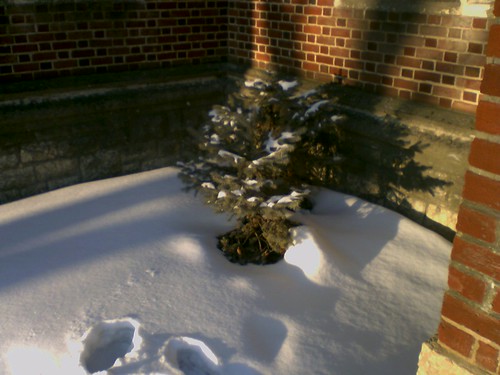
I just don't have that kind of stamina. I've twice in the past managed to sustain it for about a month; 31 Days. Every time the experience has changed the way I see the world around me. I notice things I've missed even though I walk past them every day; like that little tree ... I never noticed it until I started taking a picture a day for the 31 days of March, 2008.
This is what happened in October of last year when I did this again with a larger group of teachers from around the world:
Anyway, I'm starting this up again and you're invited along for the ride. I've already heard from a couple of Manitoba educators who are interested in doing this and some folks from MICDS in St. Louis might join in the fun too; they might even have a few students join us ... I really like that idea.
I'm going to tag all my photos 31DaysOct09. Feel free to use the same tag. Tagging all your photos allows you to create nifty little slideshows of them like the one I have above. Even if you use the same tag as me you can pull out just your photos if you want to create your own slideshow.
If you'd like to join, with or without your students, you can sign up for the flickr group I started. We're starting tomorrow, October 1st. If you start late, that's OK too. There are no rules. We're just going to have fun ... and maybe start seeing things differently together.
Math explains the world around us — makes it comprehensible — and when it's not comprehensible, when we don't understand something in the world around us, math guides our discovery ... it's all about knowing what to do when you don't know what to do.
Math is the science patterns; shouldn't we emphasize pattern recognition deliberately and explicitly in our teaching? Isn't that an important set of skills? Have I got this wrong?
Image by dkuropatwa via Flickr
The other day I was talking to a teacher who works with EAL (English as an Additional Language) students. I was reminded of a summary of teaching tips I had assembled by scouring through a pile of research articles when my department was struggling with the issue of teaching a growing population of EAL students in our school. Unfortunately I've lost all the sources. This was originally designed to be shared with just my colleagues as a quick reference sheet.
It struck me that these tips are really good for all students.
By the way, that picture is an integral written using various languages and multilingual character sets. It makes perfect (mathematical) sense if you can decode all the numbers. Can you "read" it?
I hope other teachers find this helpful. Please add your own suggestions in the comments below.
The strategies below have been collated from a variety of resources. While all may be specifically geared towards assisting the EAL learner in math, these strategies are likely to prove effective in supporting the learning of all students.
The Language of Mathematics and Teacher’s Use of Language
"Command of mathematical language plays an important role in the development of mathematical ability"
Explanations and expectations need to be articulated explicitly and completely. Don't simply expect EAL students to "pick up on" assumptions, unstated premises, or subtle nuances of meaning.
Create Language Supportive Classrooms
"Journal writing offers English Language Learners (ELLs) the opportunity to practice and develop their emerging mathematics discourse skills."
Some possible prompts for journal writing:
Connect Mathematics to Students' Background and Experiences
Between the 10th and 15th year of teaching I discovered that what was needed for these children was not an emphasis on the academic but a meaningful interaction with mature adults. The relationship with a stable, mature adult is most important.
Vary Instructional Methods
"ELLs learn best when instructional methods and approaches match their individual abilities and learning styles."
Contextual Supports for Linguistic Development
In most subject areas, EAL students should be able to grasp essential concepts, if these are presented carefully, emphasized through repetition, and clearly distinguished from finer points that the students are less able to assimilate.
Assessing, Evaluating, and Reporting on Students' Progress
Functioning all day in a second language is exhausting and demanding. Homework can take these students two to three times longer to complete.
1. Be interested in your subject.
2. Know your subject.
3. Know about the ways of learning: The best way to learn anything is to discover it by yourself.
4. Try to read the faces of your students, try to see their expectations and difficulties, put yourself in their place.
5. Give them not only information, but "know-how," attitudes of mind, the habit of methodical work.
6. Let them learn guessing.
7. Let them learn proving.
8. Look out for such features of the problem at hand as may be useful in solving the problems to come — try to disclose the general pattern that lies behind the present concrete situation.
9. Do not give away your whole secret at once — let the students guess before you tell it — let them find out by themselves as much as is feasible.
10. Suggest it, do not force it down their throats.
Our job is to awaken possibility in others ... You know you're doing it when their eyes are shining. And if their eyes are not shinning, then we have to ask ourselves, "Who am I being that my [students] eyes are not shinning?"
2 min 59 sec
Cover of Calculus Made Easy
Considering how many fools can calculate, it is surprising that it should be thought either a difficult or tedious task for any other fool to learn how to master the same tricks.
By far the best opening line for a math text ever written. Now released from copyright restrictions you can download a copy, visit the scribd.com version, or read it here.
I think I'm going to use this as the text for my High School Calculus class next year and perhaps as a supplemental text for my AP Calculus students.
Thanks to Denise for the tip. ;-)
Cool math 4 kids - math games, math puzzles, math lessons - designed for kids and fun!
http://www.primaryresources.co.uk/maths/maths.htm
maths resources for primary
Who's Counting: John Allen Paulos - ABC News
John Allen Paulos' column for ABC news: mathematics in daily life as it reads in the news.
Collection of movie clips involving Mathematics.
Visual Math Learning: A Free Online Tutorial for Teaching Math
Tags: mathematics, education, interactive, resources, graphing
Arcademic Skill Builders: Online Educational Video Games
Play these online or on the Wii
Math videos show how to solve problems step by step.
Tags: Math, Videos, education, mathvideos, Technology, number
Integrating Google Earth in mathematics
The goal of the Place Value Game is to create the largest possible number from the digits the computer gives you. Unfortunately, the computer will give you each digit one at a time and you won't know what the next number will be. You are not allowed to rearrange any of the digits you have already placed, so think carefully before you lock a number in place! Good luck!
interesting online...play with unit cubes
This is a collection of movie clips in which Mathematics appears. I'm collecting DVDs and VHS tapes of such movies. This is a working document to be extended over time.
http://iris.peabody.vanderbilt.edu/info_briefs/k8_access_center/downloads/mnemonics_math.pdf
mnemonics instructions in mathematics
The Coordinate Plane - Math Open Reference
coordinate geometry interactive platform
interesting way to visualise math concepts
Welcome to Waldomaths - mathematical applets and videos for 11- to 19-year-olds
For the teaching and independent learning of mathematics
Online Mathematics Resources
Centre for Research in Pedagogy and Practice
The Centre brings together researchers, educators and administrators to research, develop and implement new and innovative ways of teaching and learning.
Mathematics 24x7 - There is no escape...believe it or not. Mathematics is everywhere.
Just talking about Math... What do you say?
Mathematics has a reading protocol all its own, and just as we learn to read literature, we should learn to read mathematics. Students need to learn how to read mathematics, in the same way they learn how to read a novel or a poem, listen to music, or view a painting.
Free Technology for Teachers: Math Links You Might Have Missed
"links you might have missed" series with Mathematics links
Chapter 10 - Cross Sections of a Cube
Choose a cross section, then click on the points that lie on the edges of the cube to try and create the cross section. press Create to see what cross section you made, and if you want, you can rotate the cube to take a look at it. It will give you feed
You Do The Math: Explaining Basic Concepts Behind Math Problems Improves Children's Learning
New research from Vanderbilt University has found students benefit more from being taught the concepts behind math problems rather than the exact procedures to solve the problems. The findings offer teachers new insights on how best to shape math instruction to have the greatest impact on student learning.
Tags: learning, Research, Math
Droste Effect with Mathematica
Heavy coding but wow effect!
Enjoy yourself while improving your maths!!
Click on any title and solve the interactive exercises!!!
You will find an example and exercises for each subject
Collection of Math pictures
Can we be less prescriptive in our classrooms – and more successful with our students?
"This model for learning mathematics may be quite different from what teachers experienced themselves in the past where classrooms were less interactive, filled with little activity and conversation. Teachers were generally in control, directing all aspects of what was to be learned; different points of view and approaches seldom brought to the surface new ideas and insights and a high degree of redundancy meant that everybody learned the exact same thing at the exact same time.
Tags: education, teaching, teachingandlearning, school2.0, Research, mathematics, science
Remote Access: Take Pictures With Us
Basic geometry based collaborative activity to be shared with a global audience through photos in Flickr. Activity shared by Clarence Fisher.
What Came Before
Some students have already started solving and annotating their problems tonight. Feel free to watch how it unfolds on the wiki.
Over this past weekend I created a new wiki and seeded it with exam level problems. The details are posted on the front page of the wiki, but in brief, the assignment comes in two parts done over two weeks:
A Significant Contribution or Week 1
Solve a problem completely. Annotate well enough so that an interested learner can learn from you. Make the layout clean, clear, and complimentary to the articulation of the solution.
Students often think this is the hard part of the assignment. I think it's the easy part. It's more or less like a Scribe Post focusing on a single problem. Granted, some of the problems are challenging, but the timeline for this, 1 week, is supposed to make it a low pressure sort of thing. Unless they leave it for the last possible moment; most don't some do. I mean, they have a week to do something that could reasonably be assigned as an overnight homework assignment.
A Constructive Modification or Week 2
This time next week the real fun begins. (The real metacognitive work.) Each student must scan through the entire wiki looking at each solution their mates have done, find one that has an error, and fix it. They must edit someone else's work, not their own.
Week 1 was just a set up for this; this is where I think the real learning happens.
This all ties in with one of the three guiding principles I always think of as I design learning experiences for my students: Make Thinking Transparent. This is particularly well illustrated in this assignment.
Refinements or The Nuts and Bolts
The sidebar of the wiki has links to:
» the class blog.
» the grading rubric (feel free to copy it if you like, it's quite simple).
» an index of all the problems/units seeded on the wiki.
» the sitmo Google Gadget for create point & click LaTeX equations. (This makes it real easy to write math on the web.)
» equplus.net, a database of copy & paste LaTeX equations & expressions for those kids that really want to rock and roll with LaTeX.
Next in this series (when I've caught up with the backlog) is Part 6: Developing Expert Voices or Learning To Do What Mathematicians Do: create mathematics.
If you watch TED Talks you may have noticed that the visuals used by speakers at this years conference are qualitatively superior to those used in the past. TED has hired Duarte Design and assigned each speaker a small stipend to have their visuals given a makeover by the folks at Duarte. You can really see it in the visuals used in these two talks:
Barry Schwartz: The real crisis? We stopped being wise
Here's the backstory to Barry's slide makeover.
Bruce Bueno de Masquita: Three predictions on the future of Iran, and the math to back it up
Here's the back story to Bruce's slide makeover. (Seems to be offline; wonder what happened? Here's the Google Cache of the page. You can also find it on my Shared Items page.)
The post ends with this:
Rules We Live By
» Break apart big ideas into smaller bite-sized pieces.
» Simplify the message (even when you’re talking about using game theory to predict the future!)
» Give a message space to stand out and contrast to focus attention.
» Use more visuals and less words.
» Use clear, easy-to-read charts with simple shapes and colors to add texture and clarity.
If you're new to using an Interactive White Board (IWB) in your class I think this is an excellent list to use as a starting point for slide design. When designing slides for classroom instruction these are the ideas I use as guidelines. I'm working hard at evolving how I present information to my students daily. Particularly when teaching more conceptually difficult material.
This is how I introduced statistics the first time with the SMARTboard:
This is how I did it this year:
There's still lots of room for improvement in that second set of slides above. I'd genuinely appreciate any suggestions you may have about improving this particular slide deck or my approach in general. Can you suggest a specific image that might fit nicely into this lesson?
I'm going to keep trying to increase my use of visual images and since SlideShare added the ability to embed YouTube videos in each slideshow I've been trying to have at least one instructional video inserted into every day's set of slides.

The topic is "What are our kids doing online?" but I can see us talking about adults as well as how some sites are changing the way we connect socially, personally, and professionally at all ages.
You can listen live, streamed over the internet, but we'd rather have folks participate in the chat room we've created or via twitter. We're using the hash tag #cjob.
Chris has a much more detailed post up than I do. Head over there and check it out.
Hope to see you online and on the radio. ;-) The fun starts at about 9am central time in North America.
Watch this first:
OK, so this is going to sound weird coming from a math teacher — I'm liable to be run out of the club for saying it — but, in most subjects, does every kid have to learn exactly the same stuff?
Here's what I'm thinking (and I don't think it's an original thought):
Don't send them home to read and listen to the lecture, send them home to take in a short (10-15 min video) or even a micro lecture. Then change the classroom into more of a lab or studio environment. Each kid produces a paper or other artifact of what they've learned and shares it with the rest of the class either face-to-face or online; they become expert in the area they've chosen to explore and at the same time develop the research skills to learn related content when needed.
The question I try to ask myself is: What is the value added for my students by being in the same room with me? If I recorded my lecture (video or audio) and they watched it at home, did the assignments and handed them in, would they be missing something by not being here physically?
I do think my students gain value by being in the same room with me, but most often when I speak very little. I let them work through the problem(s), debate and defend their work with each other, and only towards the end, when they've collectively sucked the marrow from the bones of the problem do I either ask another question that fires them all up again or draw their attention to the finer points of how best to share their thinking on paper.
This is what the video I embedded above suggests to me. I know I'm not there yet, but man! I'd like to be.
If one of these images (all cc, I asked) strikes you in some way, follow the link back and copy it to the comments here maybe sharing what struck you. I'll start it off below.
I'm not sure if images will embed in the comments here (I'm testing this with my first comment below) but I've got apture installed on my blog so linking to the image should create a popup view of it when you hover over the link; like this.
This video has gone viral; over 15 million views to date.
Searching YouTube for David After Dentist reveals over 1800 results. In classic YouTube fashion, the video has been remixed and parodied. You'll also find that since the video went viral there is now a blog collating all the remixes, parodies, other humourous and viral videos, an Amazon store, various other ways of monetizing the video of a 7 year old boy who went to the dentist, was medicated, and took a while to fully recover his senses.
I wonder how young David is going to feel about all this in five years; when he's in high school. As he struggles to establish his own identity and "fit in," how will he feel if (when?) this video resurfaces and spreads throughout the school?
I wonder if David's parents have fully thought through the future ramifications for David; from the point of view of his future self.
It's cliché; the internet changes everything. That includes our perception of time. I think this is a really important thing to get our heads around: digital footprints can last a lifetime.
It used the be the foolish things kids did faded with people's memories. The internet has a better memory. I think kids today need to learn not only to "think before you post", but to think, from the perspective of ALL your future selves, before you post.
Really?
Driving my son and a friend of his home yesterday we were talking. They started talking about tests they have coming up in various classes. They listed those classes where "you just have to memorize that stuff." Again, math was one of those classes.
So really, what do we absolutely have to memorize in math? I do not teach memorization, although I too have told my students that they have to commit certain things to memory. In each case I emphasize they should not memorize individual facts, rather, they should identify patterns and recall the patterns. I teach mnemonics. (Is that splitting hairs?) For example, how many patterns can you find in these two columns of numbers?
So really, what do we HAVE to memorize in math?
I'd like to publish a series of posts transparently sharing how I use the SMARTboard to teach math and encourage anyone who reads/hears it to leave me suggetsions on how I might better use the affordances offered by the SB. Please share your critiques, comments, concerns, questions, complaints, confusions, uncertainties, anxieties, and suggestions for improvement with me by leaving a comment on this post or directly in the VoiceThread I've created to share my process.
I'd encourage other teachers to do the same; we could learn a lot from each other this way.
LINKS FOR THIS LESSON
Teaching Slides
Student Authoured Scribe Post
Thanks!
The first 7 to 10 days of the semester are busy, particularly the first 2 or 3. I ask each student to email me and mention the class they are taking with me and what period it's in. (Each class has their own blog.) This allows me to "capture" their email addresses in my gmail account so I can communicate with them as needed later. I copy and paste their email addresses (I hate typing long lists) into the appropriates space on the blog and invite them to be contributors to our blog. (In Blogger go to: SETTINGS > PERMISSIONS > scroll down and click on ADD AUTHOURS) I use a group blog model; each class has their own blog which will serve as the social and academic hub of our time learning together.
In our first class I discuss the same things you do: class expectations (mine of them and theirs of me), give a quick overview of the course, and something I call The Critical Path to Success. I also discuss the class blog, how scribe posts work (their contributions), and how I post the daily lesson slides to the blog and occasionally share "links for learning" (my contributions). One of the best descriptions of scribe posts I've ever read I discovered yesterday on one of the class blogs. It was in the chatbox (more about this in my next post); written by one student to another explaining what they were supposed to do when it was their turn to be scribe. PJ said:
A scribe post is basically like you are teaching the class again, but this time in your words in a way that other people can understand it. You can also recap other important things that we talk about in class (like Pi Day) so that if someone was away in our class, they would know what they missed. Also don't forget that when you scribe, you get the power to choose the next scribe.
I thought it kind of cool that he described choosing the next scribe as a "power".
The way I present information, and consequently they way I teach, has undergone dramatic growth in the last few years. I decided that I owed it to my students to develop an opening presentation that was similar to the sort of thing I do when giving a workshop. This is what my opening day talk looked like in the Fall of 2007. I podcasted this particular class so you can listen to me if you like, but I warn you, it's not compelling listening. ;-)
I updated it a bit for the Fall of 2008. This is what the latest incarnation of my opening day talk looks like:
There is no scribe for my first class which has no real mathematical content. There are also no scribes for tests days. Recently, some students have taken to publishing a personal reflection of how they felt the test went, inviting the rest of the class to share their thoughts in the comments. I love the spontaneous incidental learning and thinking that comes of students habitually publishing their thinking.
By the next morning I'll have a small handful of students signed up as contributors to the class blog. I ask for one of them to volunteer to be the scribe for that first class and remind them that they must finish their scribe by choosing the next scribe, which can be anyone in the class, and by labeling (other blog platforms call this "categories") their scribe post properly ("First Name", "Unit Title", Scribe Post). This kicks off the students beginning to take responsibility for their own learning and each other. I never choose a scribe; they do. If the scribe is absent for class one day I tell the students that they have to figure out who will cover for the absent student and decide how they want to manage this. Sometimes I lean back against the board at the front of the room and wait several minutes until they start talking and get it all sorted. I'm consistently clear that this is their responsibility; not mine.
I also begin discussing ethical online behaviour, alerting students to some of the things that can happen when we publish content online. At the end of the day I publish a post to the blog called Digital Ethics which is required reading for everyone.
In my next post in this series I'll talk a little more about the follow up to the Digital Ethics post and The Scribe List which I post to the blog as we continue getting organized for the semester. I'll also touch on how the blog evolves as a learning ecology and how I deal with certain pitfalls like students that don't have computers, email accounts, hit technical snags, or don't register for the blog. (I know I'd said I'd do that this time, but next time a really will. ;-) )

I'm Darren Kuropatwa
- I love learning; and I like to teach.