Student Voices Episode 1: Jessie


I was talking to one of my students earlier this week while helping her review over the lunch hour. I found her comments so compelling I asked her (and later her parents) if I could record and publish her comments so other students could hear what she had to say. I've long thought students need to hear from other students how they best learn to help them all learn.


This is the first in what I hope will be a series of podcasts called Student Voices. I'm hoping to have one of these short conversations with a student published each week.


I was inspired by the powerful presentations done by my students on Monday at the Pan-Canadian Interactive Literacy Forum. Hearing how students talk powerful learning experiences in their own words fascinates me; I find it very compelling when I begin to doubt if "all this web 2.0 stuff" is worth mine and my students efforts. Listening to Jessie talk gave me a shot in the arm at a time when I really needed it.


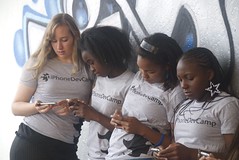
In this episode Jessie, a grade 12 Applied Math student, shares how she uses her class blog to learn and describes her personal "tipping point" from being confused to understanding the class material very well. She also discusses the value of learning conversations and how sometimes being a "teacher" and sometimes a student helps her learn.


Please feel free to leave Jessie your comments here or on this post on her class blog. You can also find the archive of her most recent online work in her class blog.


(Download File 5.6Mb, 11 min. 40 sec.)


UPDATE


I cross posted this to all my class blogs. I'm thinking this might be a way to help build community between them and encourage cross commenting by students.


Photo Credit: Kids of conversation by flickr user Kris Hoet

Students Rock! the Pan Canadian Literacy Forum

Chris and I were invited by Cheryl Prokopanko, along with six of our students, to participate in a panel presentation at Canada's first Pan-Canadian Interactive Literacy Forum.


Preparing for today led to a collaboration that involved introducing my students to Box.net, where we shared our evolving presentation slide decks in a space where we shared access, and several skype calls with Chris.


Cheryl opened the presentation with an overview of Manitoba's new Literacy in ICT curriculum continuum which has evolved over the last several years (next year is the first year implementation is required by all schools in the province). It began with this video ...


Then Cheryl introduced Chris and I and our students. Chris and I bookended the kids presentations. Chris made some opening remarks, I made some closing remarks (actually, it was an invitation). But the highlight of the entire event was the kids. They so rock! Watch and see ...


... and it continues with my students, then me, here ...


We ended off with a question and answer session (Podcast: 16.8 Mb, 27 min. 55 sec. Now available as a slideshow with photos from the presentation) which you may find interesting. Some of it is hard to hear but there are some really great moments; like when one of the grade 8 students explains texting to a 63 year old member of the audience.


When it was all over the kids were swarmed by people who wanted to chat with them and hear their thoughts. Chris and I hung back and just left them to soak up all the well deserved accolades they collected. Each kid spoke for about 5 minutes and each kid must have spent over 5 hours preparing for it; and it showed. Chris and I are so proud of them.

Article 13, Al Upton, and the minilegends

Just published this to all my class blogs. We discussed the issue in class today. It's a small world. The goings on in Australia may reverberate here in Canada.


If you'd like to leave a comment to Al Upton and the minilegends in Australia click on the picture below to get to their blog.


You can also read more about Article 13 and the Convention on the Rights of the Child here. This movie illustrates what it's all about:


31 Days


Working online has made me more digitally literate. More than that, as I share what I've learned with others in various workshops and presentations I've been struck how my thinking about teaching has evolved to include a storytelling element and become more and more visually based. I've begun to think differently. flickr is the place I go looking for inspiration and metaphors to use in my classroom each day and in the presentations I give.


A number of people I know have taken D'Arcy Norman's lead and joined his 366 Days flickr group. Many report that after a while they experience a change in the way the view the world around them. I don't think I have the stamina to go 366 days (and I missed the start date for 2008) so I'm trying out my own experiment. One picture each day for the 31 days of March; taken with my cell phone. March is a month of dramatic change in the weather here in Winnipeg. We'll see how this plays out in my little experiment.


Also, my students have all begun their first flickr photo assignments for this semester. Since I'm asking them to look at their world differently I thought it only fair that I do something similar. I'm thinking my next photo experiment, in another month, might be to take a photo a day somehow connected to noticing the math in the world around me.


For now, here is the bucket full of photos I've taken so far. New pictures will be added daily and this slideshow will update itself automatically.


I wonder if 31 days is long enough for me to experience the change in visual perception I've heard others describe?

Network Spaghetti: Mentoring


I think being able to understand how different people understand the same idea is essential to deep learning. That's why having mentors work with my students has been such a critical part of how I orchestrate their learning spaces; their blogs.


My classes have been enriched beyond measure by the thoughtful, and thought provoking, comments left my students by visitors to their blogs. Lani Ritter Hall (Ohio), Roland O'Daniel (Kentucky), and Emina Alibegovic (Michigan) have each pushed my students thinking in different ways. Lani, as a non-math educational consultant, has always asked them to dig deep into their learning styles and motivation for success. Roland, as a former math teacher, has focused on both the motivation and the specific content of what they write. And Emina, as a professor of mathematics at the University of Michigan has pushed them to dig deep and explore their mathematical (mis)understandings to better understand what they are learning.


Last semester Alec Couros and I collaborated to have two of his classes of student teachers (Regina, Saskatchewan) mentor my grade 10 Consumer Math class. The experience helped my kids grow as learners and Alecs' students grow as teachers.


Some of my students have been mentored for three years now, having taken all their high school mathematics courses with me. And they're starting to pay it all forward ... and backward.


I've blogged before about the excellent work two of my students, Grey-M and Mr SiWwy, are doing with Clarence and Barbara's classes in the Thin Walled Classroom. Now Mark has begun another unique mentorship project with my current Pre-Cal 40S (grade 12 pre-calculus) class.) (I'd be grateful towards anyone who left m@rk a comment over there.)


Mark took Pre-Cal 40S and has already earned his grade 12 credit. He did really well and wants to upgrade his mark so he's taking it again. All he really wants to do is challenge the final exam. We discussed it. He decided it would be a good idea to take the class again. He's taking Advanced Placement courses that conflict with the timetable for my class. We've worked out an arrangement whereby he can stay on top of his work without attending every one of my classes (all a repeat for him) so he can pursue his Advanced Placement courses concurrently. So Mark is mentoring his classmates, who he doesn't see every day, and he's doing some really amazing work!! Like Grey-M and Mr SiWwy, he's leaving comments on the class blog and archiving them with some reflections on a separate blog in order to aggregate all the content he's producing in one place. This allows me (and anyone else) to easily follow his work. Also, it will be a concrete archive of his learning and teaching that he can take with him when he leaves high school.


Recently, I've begun talking with Chris Lehmann (the principal at SLA) about having one or more of my students mentor one of the students at the Science Leadership Academy in Philadelphia who wants to pursue some advanced math on her own. Mark is the first student to volunteer to do this.


All these connections criss cross in all sorts of unexpected ways. It starts to look like network spaghetti:


Lani mentored my kids for almost three years. They pay it back by mentoring Clarence's kids and Lani starts a conversation with Grey-M and Mr SiWwy (my two student mentors) about effective mentoring in the course of their work with Clarence's and Barbara's kids. When Alec's student teachers come online and ask: "What does a good mentor's comment look like?" I point them to a comment Grey-M (my student) left one of Clarence's kids. So Alec's students learn the art of mentoring from my older students and pass that on to my younger (mathematically wounded) students all the while Lani and my two older students (Grey-M and Mr SiWwy) are engaged in this high level discussion (call it PD) about how to be effective mentors the results of which model good mentorship for the student teachers in Regina. Full circle.


And now m@rk is continuing this thread with his classmates on their class blog.


I suspect Al Upton will be having similar experiences; if he hasn't already. ;-)


Photo credits: thinking red,green and black by jmsmytaste


looking up by platinumblondelife


FSM At Atlantis by WilWheaton