UPDATE
Joe, one of the folks who attended the session on Friday, has shared the Graphing Calculator Lease Form he uses in his school. You can see it here. Feel free to copy and edit or or just print it as is.
Thanks Joe!
- 1:08 PM
- 0 Comments

UPDATE
Joe, one of the folks who attended the session on Friday, has shared the Graphing Calculator Lease Form he uses in his school. You can see it here. Feel free to copy and edit or or just print it as is.
Thanks Joe!
Chris Harbeck's class blog hub (innovator par excellence!)
Ryan Maksymchuk's suite of class blogs (more scribing class blogs than you can shake a stick at!)
Jim Homan's Cathoilic Morality wiki
Mr. Marti's precalculus class blog
Reversearp's (an alias I believe) precalculus class blog
Mrs. Everard's AP Calculus class blog
Image by dkuropatwa via Flickr
This is the slidecast from one of three talks I gave on Friday October 9, 2009. I was in Virden Manitoba participating in the NIBBLE Conference for the Fort La Bosse School Division.
More coming soon. Everything will be aggregated on the Senior Years Information and Communication Technology wiki I'm maintaining to share all the work I do in Manitoba with teachers across the province ... and you.
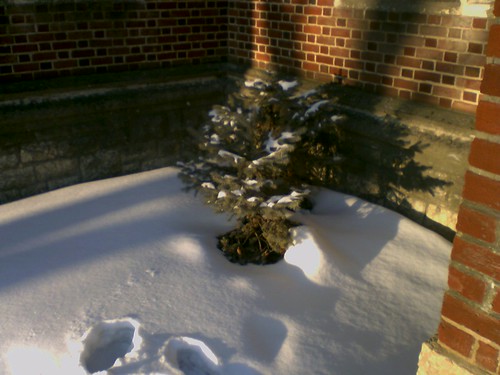
I just don't have that kind of stamina. I've twice in the past managed to sustain it for about a month; 31 Days. Every time the experience has changed the way I see the world around me. I notice things I've missed even though I walk past them every day; like that little tree ... I never noticed it until I started taking a picture a day for the 31 days of March, 2008.
This is what happened in October of last year when I did this again with a larger group of teachers from around the world:
Anyway, I'm starting this up again and you're invited along for the ride. I've already heard from a couple of Manitoba educators who are interested in doing this and some folks from MICDS in St. Louis might join in the fun too; they might even have a few students join us ... I really like that idea.
I'm going to tag all my photos 31DaysOct09. Feel free to use the same tag. Tagging all your photos allows you to create nifty little slideshows of them like the one I have above. Even if you use the same tag as me you can pull out just your photos if you want to create your own slideshow.
If you'd like to join, with or without your students, you can sign up for the flickr group I started. We're starting tomorrow, October 1st. If you start late, that's OK too. There are no rules. We're just going to have fun ... and maybe start seeing things differently together.
Math explains the world around us — makes it comprehensible — and when it's not comprehensible, when we don't understand something in the world around us, math guides our discovery ... it's all about knowing what to do when you don't know what to do.
Math is the science patterns; shouldn't we emphasize pattern recognition deliberately and explicitly in our teaching? Isn't that an important set of skills? Have I got this wrong?
Image by dkuropatwa via Flickr
The other day I was talking to a teacher who works with EAL (English as an Additional Language) students. I was reminded of a summary of teaching tips I had assembled by scouring through a pile of research articles when my department was struggling with the issue of teaching a growing population of EAL students in our school. Unfortunately I've lost all the sources. This was originally designed to be shared with just my colleagues as a quick reference sheet.
It struck me that these tips are really good for all students.
By the way, that picture is an integral written using various languages and multilingual character sets. It makes perfect (mathematical) sense if you can decode all the numbers. Can you "read" it?
I hope other teachers find this helpful. Please add your own suggestions in the comments below.
The strategies below have been collated from a variety of resources. While all may be specifically geared towards assisting the EAL learner in math, these strategies are likely to prove effective in supporting the learning of all students.
The Language of Mathematics and Teacher’s Use of Language
"Command of mathematical language plays an important role in the development of mathematical ability"
Explanations and expectations need to be articulated explicitly and completely. Don't simply expect EAL students to "pick up on" assumptions, unstated premises, or subtle nuances of meaning.
Create Language Supportive Classrooms
"Journal writing offers English Language Learners (ELLs) the opportunity to practice and develop their emerging mathematics discourse skills."
Some possible prompts for journal writing:
Connect Mathematics to Students' Background and Experiences
Between the 10th and 15th year of teaching I discovered that what was needed for these children was not an emphasis on the academic but a meaningful interaction with mature adults. The relationship with a stable, mature adult is most important.
Vary Instructional Methods
"ELLs learn best when instructional methods and approaches match their individual abilities and learning styles."
Contextual Supports for Linguistic Development
In most subject areas, EAL students should be able to grasp essential concepts, if these are presented carefully, emphasized through repetition, and clearly distinguished from finer points that the students are less able to assimilate.
Assessing, Evaluating, and Reporting on Students' Progress
Functioning all day in a second language is exhausting and demanding. Homework can take these students two to three times longer to complete.

I'm Darren Kuropatwa
- I love learning; and I like to teach.