
Are Laptops Really Bad For Learning?
4:00 PM A study was recently published in the Journal of Psychological Science and subsequently reported on in The Atlantic, Scientific American, The Association for Psychological Science, several educational blogs, The Washington Post, and elsewhere online. The study is titled: The Pen Is Mightier Than the Keyboard: Advantages of Longhand Over Laptop Note Taking. The general consensus seems to be that people learn more effectively when taking notes using pen and paper rather than laptops.
THE EXPERIMENTS
Experiment 1
• Watch 5 TED Talks on YouTube.
• Take notes with either a laptop or pen and paper.
• Afterwards participate in distracting activities in another room for 30 minutes.
• Take a quiz on the content of the TED Talks.
Pen and paper note takers did slightly better at factual recall, significantly better on conceptual questions. The laptop note takers took more notes (they transcribed more content) than those using pen and paper (they summarized & synthesized more content).
The research on note-taking suggests "more notes" is a sign of more effective note-taking, however, verbatim transcription is a sign of shallow cognitive processing compared to summarizing and synthesizing.
Experiment 2
The same set up as Experiment 1 with one change. Laptop note-takers were alerted to the shallow cognitive processing associated with transcription style note-taking and told to avoid it. They were also told to take notes as they would in a classroom.
The results were the same: more notes taken by people using laptops, pen and paper note-takers did better on the follow up quiz.
Experiment 3
Again, the same set up. And again, with one difference. Since people typically review their notes before taking a test students were given 10 minutes to review their notes before taking the follow up quiz.
Again, more notes were taken by people using laptops. Pen and paper note-takers did better on the follow up quiz.
THE CONCLUSIONS
Many people concluded from this study that students shouldn't take notes with a laptop; handwriting is better. Mueller and Oppenheimer, the authors of the study, concluded:
Although more notes are beneficial, at least to a point, 'if the notes are taken indiscriminately or by mindlessly transcribing content, as is more likely the case on a laptop' than when notes are taken longhand, the benefit disappears. Indeed, synthesizing and summarizing content rather than verbatim transcription can serve as a desirable difficulty toward improved educational outcomes (e.g., Diemand-Yauman, Oppenheimer, & Vaughan, 2011; Richland, Bjork, Finley, & Linn, 2005). For that reason, laptop use in classrooms should be viewed with a healthy dose of caution; despite their growing popularity, 'laptops may be doing more harm in classrooms than good.' (p. 1166)
 IS THAT WHAT THE RESEARCH SAYS?
In short, no.
The study does show that using a laptop is highly correlated with verbatim note-taking; we know that's not an effective way to take notes as opposed to summarizing and synthesizing.
John Jones, Assistant Professor of Professional Writing and Editing at West Virginia University, also points out a problem with the instructions given to students in the second experiment. Namely, that students were told to take notes as they typically would in class when using a laptop. The warning against verbatim note-taking may have been ignored in the face of the students falling back on what they typically would do with their laptops. It's unlikely their note-taking habits would have been changed by a brief verbal warning in an unfamiliar learning situation.
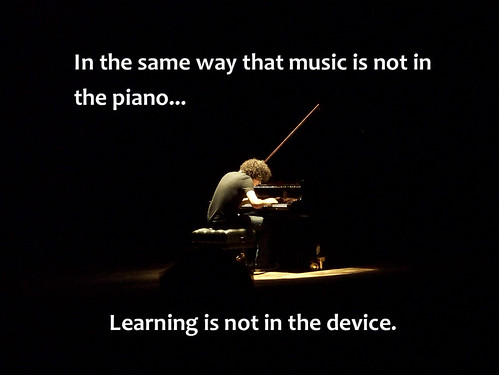
LEARNING ISN'T IN THE DEVICE
In the same way learning to ride a bike and learning to drive a car require different learning experiences using different learning tools also requires different learning experiences. Students don't automatically know how to take notes; it's a learned skill, one we have to teach.
In the words of John Jones:
I am not criticizing Mueller and Oppenheimer's research, only the implications they draw from it. The correlation between laptop use and verbatim note taking is incredibly useful information for it allows educators to address how students use their tools. It certainly does not suggest that laptops are "harm[ful]" or should be restricted. The "pen" is not "mightier than the keyboard."
Moreover, we have to ask, is taking notes in a lecture hall what we mean by "learning"? Surely what we mean by "learning" is a far richer experience than that.
Cathy N. Davidson, Professor of Interdisciplinary Studies at Duke University, has more to say about this study as well. In particular, she says people are asking the wrong question.
What do you think? What do you mean by "learning"?
Cross posted at the Canadian K12 Blueprint.
photo credits: creative commons licensed (BY-NC-SA) flickr photo by Tulane Publications, creative commons licensed (BY-NC-ND) flickr photo by Newman University , creative commons licensed (BY-NC-SA) flickr photo by ransomtech


4 comments
Very interesting article ... I have mixed opinions about the laptop vs. pen; though as a student and tutor, I find a lot of power in the laptop and Google. If my student is having a hard time, ten seconds and I have access to the greatest minds available. I guess if I have to choose, I take laptop.
ReplyDeleteI think you've erected a straw man here. The title of the post -- "Are Laptops Really Bad For Learning" -- is hyperbolic. The study looked at the use of laptops specifically for note-taking, which is often part of, but not all of, the process of learning in present-day classrooms.
ReplyDeleteAnd then you add slides, such as the one that claims "learning is not in the device". They never said that -- that's purely a straw man that you erected to try to make the authors of the study seem stupid.
Then you quote the conclusions of the published study and say the authors are wrong. The conclusion is simply three sentences, and I believe each is fully supported by the research done, especially considering the judicial use of "may".
So let me repeat and number the conclusion and you tell me which statement is unsupported by the research.
1. "Although more notes are beneficial, at least to a point, 'if the notes are taken indiscriminately or by mindlessly transcribing content, as is more likely the case on a laptop' than when notes are taken longhand, the benefit disappears."
2. "Indeed, synthesizing and summarizing content rather than verbatim transcription can serve as a desirable difficulty toward improved educational outcomes (e.g., Diemand-Yauman, Oppenheimer, & Vaughan, 2011; Richland, Bjork, Finley, & Linn, 2005)."
3. "For that reason, laptop use in classrooms should be viewed with a healthy dose of caution; despite their growing popularity, 'laptops may be doing more harm in classrooms than good.' (p. 1166)"
So again, please tell me which statement(s) you believe are wrong.
So, I think the sentiment that the image quotation expresses is right on. It's less about the device and much more about the user's skills, mindfulness, and understanding of the learning process. I do think it is sometimes true that learners can feel artificially empowered with new devices in their hands (ie. more notes that look great are better) and give too much ownership over learning to the device (or the teacher, for that matter). Learning is always about sense-making. That can be done with a keyboard or a pen. Simply "taking notes" can have no correlation with sense making at all, as the first conclusion points out.
ReplyDeletePart of the difficulty with this type of discourse and experimentation is that it really doesn't measure learning, but the abilities to retrieve from memory and test well. Those tasks do not always reflect learning.
ReplyDeleteAnd what about the different learning styles of students? For those who have problems writing manually but can type with ease, the laptops have been a Godsend.
I have to echo earlier sentiments that taking notes on keyboard is a learned skill, much like as I believe she reflected, highlighting. At first you are trying to capture everything, but then with practice comes the ability to focus on what is important to learning, not just recording.
Note: Only a member of this blog may post a comment.