The Ten Commandments

From the archives ... I started writing this post in November of 2007.


A LONG TIME COMING


A while back, Dean and Bud got me thinking. Bud's tweet contains more than a kernel of truth.


Shortly after reading Bud and Dean I was listening to David Suzuki on the radio. He mentioned in passing the idea of "in depth news reports" on television. Generally, that means they're going to talk about an issue for about two minutes. Some issues need to be explored in more depth than that. I think pedagogy is one of those issues. In particular, I think I need to explore my own teaching, articulate my own pedagogical practices, open them up to scrutiny and shore up the weak bits.


George Polya's ideas have been very influential on me and my evolution as an educator. Since reading his Ten Commandments For Teachers I have tried to model them in my practice. Although Polya (1887-1985) is no longer alive, I consider myself one of his students. This series of blog posts is my record of what I'm learning about the craft of teaching.


IN BROAD STROKES


In chapter 14 of Polya's book, Mathematical Discovery, he talks about the teacher's attitude and structures his thinking around what he calls The Ten Commandments For Teachers. This is the first in a series of posts digging into this in depth; maybe four, maybe ten; one for each commandment. We'll see.


Although I've been thinking about it for a long time, I've got more questions than answers about these commandments. I want to share my thinking and questions here because:


(1) I want to capture my where my thinking is at today so I can come back and reconsider it in the future.


(2) I'm hoping people wiser than I might share some of their insights. I'm hoping the give and take inherent in blogging about it might push my thinking and practice; make me a better teacher.


So push back at any weak bits below or share your own teaching tip.


THE TEN COMMANDMENTS FOR TEACHERS


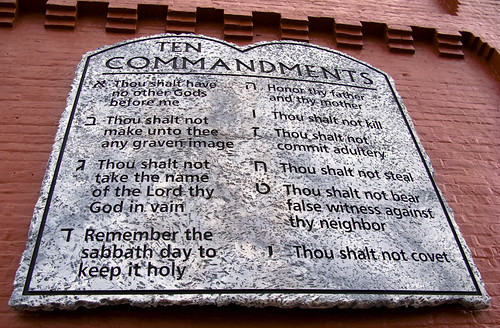
In chapter 14 of Mathematical Discovery Polya lists his Ten Commandments For Teachers. They have been a guiding light for me as a teacher since I first read them.


1. Be interested in your subject.


2. Know your subject.


3. Know about the ways of learning: The best way to learn anything is to discover it by yourself.


4. Try to read the faces of your students, try to see their expectations and difficulties, put yourself in their place.


5. Give them not only information, but "know-how," attitudes of mind, the habit of methodical work.


6. Let them learn guessing.


7. Let them learn proving.


8. Look out for such features of the problem at hand as may be useful in solving the problems to come — try to disclose the general pattern that lies behind the present concrete situation.


9. Do not give away your whole secret at once — let the students guess before you tell it — let them find out by themselves as much as is feasible.


10. Suggest it, do not force it down their throats.


MODELING PASSION: Be Interested In Your Subject


Polya identifies the single most powerful and infallible teaching method: "If the teacher is bored by what he is teaching it is a certainty that all his students will be too." I believe the inverse is also true: If a teacher is interested in what they are teaching their students will be too. Actually, "interest" by itself may not be enough; passion is a virus. There is a contagion in passion that can be passed on. I would rewrite Polya's first commandment as: "Be passionate about your subject." If you can't do that then I guess interest will have to do but if you don't have even that, do something else.


If you were a student in grade 8, and your teacher began a new unit of study like this what do you think your engagement with the material might be? Passion Based Learning is powerful stuff. There's something magnetic about a teacher who is passionate about what they are teaching. Passion leads to Interest leads to Life Long Learning. Kids need to see that their teachers are interested with their subject and constantly trying to get better at what they do. If we don't model the drive for excellence in what we teach why should they be interested in doing excellent work in our classes?


The teacher's most powerful pedagogical tool in their toolbox is tucked away in their attitude, demeanor and engagement with what they are teaching; we call it modeling. It's such a fundamental idea. Surprisingly, some quick searching on the net reveals very little written about the importance of modeling in education as a general pedagogical practice. Even wikipedia has very little to say about it; the closest article to this idea is called Modelling (psychology). It seems to me we need a few good educators to flesh this article out a bit on wikipedia.


A while back Dean asked, Can A Fat Man Teach Phys. Ed.? His answer: "Yes, but ..." It all comes back to the importance of modeling.


I'm reminded of Benjamin Zander who says:


Our job is to awaken possibility in others ... You know you're doing it when their eyes are shining. And if their eyes are not shinning, then we have to ask ourselves, "Who am I being that my [students] eyes are not shinning?"


What's the Value Added?

Cross posted from a ning community I'm in.


Watch this first:


OK, so this is going to sound weird coming from a math teacher — I'm liable to be run out of the club for saying it — but, in most subjects, does every kid have to learn exactly the same stuff?


Here's what I'm thinking (and I don't think it's an original thought):


Don't send them home to read and listen to the lecture, send them home to take in a short (10-15 min video) or even a micro lecture. Then change the classroom into more of a lab or studio environment. Each kid produces a paper or other artifact of what they've learned and shares it with the rest of the class either face-to-face or online; they become expert in the area they've chosen to explore and at the same time develop the research skills to learn related content when needed.


The question I try to ask myself is: What is the value added for my students by being in the same room with me? If I recorded my lecture (video or audio) and they watched it at home, did the assignments and handed them in, would they be missing something by not being here physically?


I do think my students gain value by being in the same room with me, but most often when I speak very little. I let them work through the problem(s), debate and defend their work with each other, and only towards the end, when they've collectively sucked the marrow from the bones of the problem do I either ask another question that fires them all up again or draw their attention to the finer points of how best to share their thinking on paper.


This is what the video I embedded above suggests to me. I know I'm not there yet, but man! I'd like to be.

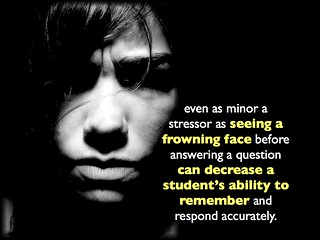
Thought Provoking Images ...

... not all, but many of them. What I really like about this set is that the fellow who puts them together often references and links to the source articles or research where the snippets are taken from.


If one of these images (all cc, I asked) strikes you in some way, follow the link back and copy it to the comments here maybe sharing what struck you. I'll start it off below.


I'm not sure if images will embed in the comments here (I'm testing this with my first comment below) but I've got apture installed on my blog so linking to the image should create a popup view of it when you hover over the link; like this.


Sharpening The Saw

I've been using a SMARTboard in my class for a little more than two years now. I know I've seen dramatic growth in the way I teach and present information to my students in no small part because of it.


I'd like to publish a series of posts transparently sharing how I use the SMARTboard to teach math and encourage anyone who reads/hears it to leave me suggetsions on how I might better use the affordances offered by the SB. Please share your critiques, comments, concerns, questions, complaints, confusions, uncertainties, anxieties, and suggestions for improvement with me by leaving a comment on this post or directly in the VoiceThread I've created to share my process.


I'd encourage other teachers to do the same; we could learn a lot from each other this way.


LINKS FOR THIS LESSON


Teaching Slides


Student Authoured Scribe Post


Thanks!

CJOB Reflections

Friday's interview with Richard Cloutier was fascinating from a few different perspectives:


The View From The Studio


Richard was a wonderful host and I found myself taken with the entire process of putting together a radio show. He started working on this show months ago when we met over coffee. He than came to see me teach a couple of times and we had a chance to talk about how it went after each class. In one class my SMARTboard was broken so he really wasn't seeing any technology in the classroom per se other than mentions of what was happening online in the class blog. The second time we did have the SMARTboard up and running but the class was a very "meat and potatoes" algebra lesson. We did get a chance to look at how I used the SMARTboard to refer to the previous night's scribe post on the blog, how I pulled in a video from YouTube to link the dry content they were learning to some useful mental math, and how I tried to have the kids on the board more than I. (Actually, I've decided to begin analyzing my lessons and sharing that online. I hope to garner suggestions for my instructional design and more effective use of the SMARTboard. That particular lesson will be the first in that series which I'll publish here shortly.)


Richard had every minute of the show planned to the second. Nonetheless he was constantly communicating with his producer to change things midstream in response to the feedback from the audience. He was taking in email live, on the fly, working the phones, planning the upcoming sequence, coordinating those of us live in the studio with Sheryl, Dean, and Wes on the phones as well as the other callers on the phone. We wanted to also monitor the Chatterous space but couldn't get through the network filter; an issue, it seems, that's not exclusive to education. I think there's work for Clarence in the world of mainstream media professional development. ;-)


In the last week and half since the show it seems to have made a small splash online. The audio has been dowloaded over 500 times and blog reflections have come in from around the world:


Wes Fryer (Edmond, Oklahoma): pre-interview post


podcast recording


post-interview refelction


Donna DesRoches (North Battleford, Saskatchewan): A Day of Learning


Stuart Meldrum (Hawick, Scotland): Teachers take over the Canadian airwaves


Neil Winton (Perth, Scotland): New Year, New Connections, New Learning


Chris Harbeck (Winnipeg, Manitoba): A day listening to Darren on the Radio


John Evans (St. Francois Xavier, Manitoba): Darren Kuropatwa Interview on CJOB Friday, January 2, 2009


Wes Fryer - follow up post (Edmond, Oklahoma): Contrasting recent Oklahoma City and Winnipeg morning radio coverage about education


Alice Barr (Yarmouth, Maine): Week 1 of 2009 and already some amazing learning!


One common thread through all these reflections was the engagement everyone felt in the online chat. It was an opportunity to continue meaningful conversation during commercials. Over 1000 comments were shared over the three hours of the show. Here's some of what happened in the chat:


There were between 30 and 50 people in the chat at different times. They came from:


  • Maine, USA

  • New Hampshire

  • Edmond, Oklahoma

  • St. Francois Xavier, MB

  • Perth, Scotland

  • Los Angeles, CA, USA

  • Harrisburg, PA, USA

  • North Battleford, Saskatchewan

  • Winnipeg , MB

  • Charters Towers, QLD, Australia

  • Farmington, Maine, USA

  • Fort Gratiot, MI, USA

  • Wales UK

  • Charlottetown, PEI, Canada

  • Philadelphia, USA

  • Moose Jaw, Saskatchewan


Folks shared links & tips (kick youtube, snackr.net, and many more) and quotes from the show that resonated with them.


A real sense of community developed by the end. Many participants in the chat added new people to their blogrolls, exchanged twitter usernames, and contact information.


What's Next?


A number of other people are thinking about ways to engage the mainstream media in their communities around the world. What will happen here in Winnipeg? Well, maybe more people reading and commenting on edublogs, joining the conversation, more local attention for the good work my students have done and are doing. Or maybe not.


The Last Word


... in the chat was about penmanship. A valid point I think. Emphasis my own.


There is no excuse for the lack of skills of today's students. Successful handwriting can be taught to anyone in a short period of time, with a little effort on the part of the teacher. When I taught school, I reduced handwriting down to ten easy lessons, and with a plan of attack for the students to use on their own. I can boast an unusually and significant success rate. One of my lessons was entitled "One Letter at a Time". Pick a letter. Decide how you want it to look. Learn how to write it very slowly and deliberately. Then for a week or so, every time you write it, take the time to do it properly. When satisfied, choose another letter, and repeat the procedure. No student ever gets through the whole alphabet. However, overall penmanship improves drastically.

Debating Standards Tests

Last night on twitter I tweeted:


That started the exchange below between myself and Gary Stager. Chris Lehmann joined in and we had a lively debate. I've decided to archive it here in response to the various communications I've received about it. Maybe extend the conversation a bit.


Gary and I


DkuropatwaGarystagerPart1of4


DkuropatwaGarystagerPart2of4


DkuropatwaGarystagerPart3of4


DkuropatwaGarystagerPart4of4


Chris Lehmann joined in. Chris' tweets should be interlaced with those of Gary and I above but summize.com doesn't do that. You can probably figure out where Chris' tweets fit in from the context of what came before.


DkuropatwaGarystagerChrislehmann


Ian Hecht added this to the debate:


These things happen on twitter. While it's happening it feels like something of moment. Time passes, passions cool, and we realize we haven't necessarily added something new to an age old debate but perhaps we've articulated our thinking, and reasons for believing as we do, a little bit better. We might also come to respect the reasoned positions of colleagues who disagree with us and walk away having learned something about ourselves and each other. Identifying Similarities and Differences is one of the most powerful instructional strategies don't you know. ;-)

And Calculus For All: Update

Why YouTube?


In the comments to my last post I was asked why I chose to use YouTube instead of TeacherTube as a platform for my students to share their videos. I answered:


I chose YouTube for three reasons:


(1) That's where the kids go for video. They feel comfortable there and have their own accounts from which they publish video outside of school. This allows me to model some digital ethics vis a vis what do you and what don't you publish on YouTube.


(2) That's where all the people are. There is a significant math community on YouTube and I am hoping to draw their attention and perhaps participation which would add value to the assignment in terms of authenticity and audience.


(3) Kids think TeacherTube is for teachers, not them. That detracts somewhat from the value added by publishing publicly online.


A number of people have left comments for my students on their class blog. Thank you so much for that. In one of those comments pirategirl mentions how slow TeacherTube can be. I guess we can add that to my list of reasons above.


Copyright


As part of this assignment we talked about copyright and I emphasized that using copyrighted material (music) is considered stealing unless they have permission to use the content. Generally, I believe that using 30 seconds or less of copyrighted music falls under Canadian Fair Dealing guidelines. (If I'm wrong about this I welcome the correction.) As part of this discussion I pointed the students to Jamendo where they could find free music to use without worrying about any copyright infringements.


I'm really proud of the way they all dealt with copyright issues and how they credited all the sources they used. Click through to their YouTube videos (see below) to read the details they included not only in the videos but in the informational text that accompanies their work.


The day before the deadline for students to publish their videos one of them left this comment on their class blog:


Maybe JAMENDO should be my name =D


it helps a lot.. thanks..


STATUS: currently cutting down 1:30 to 0:30 s.... 0__o


I was particularly chuffed about that "status update." (See the short podcast below.)


The Videos & The Podcast


Here are the four videos that the student groups generated (the 30 second time limit did not include credits) followed by a brief podcast reflection we did on the last day of classes before the winter break. Give it a listen, this project isn't over yet ...


Ben and Zeph: Calculus Commercial


Kristina, Jamie, & Joyce: YE OLDE DERIVATIVE


Paul, Shelley, & Yinan: Team PSY Derivatives Commercial


Francis, Lawrence, & Justice: Calculus commercial complete


The Podcast Reflection


(Download mp3 file, 3.3 MB)


One of the things we learned was that 30 seconds is too short. The next round of videos will have a 60 second time limit. They'll all be published by the end of January. Stay tuned. ;-)


Photo Credits: YouTube and Joost by flickr user thms.nl


Vintage Copyright by flickr user Ornithorynque

The Permanence of Ephemera


I was listening to the radio in the car tonight on the way home from a parent info night at my kids school and thinking about email. Many people don't regard email as meaningful communication; it's not really connecting because it's so transient. Like online ecards. All this online stuff is so ephemeral. It's not as meaningful as stuff that takes more time to do, like sending a "real" card.


I don't buy that.


The ephemera of online "stuff", stuff you can't touch, is an illusion. Places like the Internet Archive and OurMedia.org (actually, they're in cahoots with each other) allow you to store an unlimited amount of your digital "stuff" online for free, forever.


This got me thinking about my students class blogs. Some of them are four years old now.


Those students (who were in grade 12 at the time) are in University now or have entered the workforce and are living their lives far beyond the boundaries of the classroom where we met. The papers they handed in, the exams they wrote, the assignments they did in class, all the "real" stuff they did is long gone. Irretrievable really.


The digital stuff they did, the scribe posts they wrote, their reflections on where they were in their learning and what was going on in their lives as it impacted them at school, the digital photographs they took, the projects and assignments they published online, they're all still there and they will likely remain there for a considerable amount of time to come. They will likely be able to show off their finest stuff to their kids. Perhaps even their grandkids some day.


It seems to me these digital ephemera have a lot more permanence than any of the paper and pencil work they did in school.


I received an email from a student of mine from about four years back. It was a thank you note. The kind of note a teacher is blessed with rarely. Perhaps once in a career. I'm keeping it. Backed up in two different online spaces. I don't know why, I just want to. It hasn't added any clutter to a busy household with four kids in it. It has added meaning to what I did four years ago and what I'll continue trying to do tomorrow morning.


Just because digital "stuff" is easy to create doesn't make it less valuable. In many ways it adds value, and permanence.


Then again, maybe it isn't so easy to make "digital stuff"; meaningful digital stuff. I'm still trying to get my head around it all.


Photo Credit: Elegant green wisp by flickr user Cheekybikerboy

How Flickr Threw a Switch In My Head

Last year, one of the people in my aggregator, D'Arcy Norman, published a video to share the results of his year long experiment: he took a picture every day for a year and published it to his flickr account. He called the experiment 365 Photos. Actually, an entire community has grown up around this idea on flickr; it wasn't D'Arcy's idea originally, there are over 1200 "365 Days" groups. I don't know who started this originally but it seems like a natural extension of publicly sharing your photos.


D'Arcy said a switch got thrown in his head. Watch his video of the results; as you watch you'll get a sense of what his year was like, when and where he went on vacation, his love for his son, the things he finds interesting, but pay particular attention to how he uses perspective, how sets up his "shots", and the things in his world he notices:


As the new year rang in for 2008 several other people in my aggregator decided to join D'Arcy in his new experiment: 366 Photos (2008 is a leap year). After several weeks many started writing about how their visual perception changed as a result of doing this. They started noticing things they hadn't before, the quality of the photos they took (of things, family, friends, events, etc.) improved dramatically, and a switch in their heads flickred.


I came late to this party for a number of reasons, not the least of which is that the "every day for a year" commitment intimidates me. So, in March I started my own experiment: 31 Days.


There's a bit of folk wisdom that says it variously takes 21 or 28 days to create (or break) a habit. (15 minutes a day every day. If you miss a day just keep going until you get to 21 — or 28 — days in a row.) I've been able to find no verifiable research to back this up so make of it what you will. In any case, I did find that my 31 Days experiment lead to a change in the way I see the world and use visual imagery in my teaching.


Now, this part wasn't planned, but as I've used flickr more and more I've become more and more interested in taking "interesting" pictures.


As a math teacher I was fascinated to discover that photographers have long known of and used a mathematical definition for beauty. It's based on the number φ, phi (one H of a lot cooler than π, as my students say), which it turns out is embedded in the the natural world in all sorts of ways including the various dimensions of our own bodies. I digress, that's a post for another time. ;-)


I stumbled upon an online photography course over at morgueFile.com. I've only read through Lesson 1: Composition And Impact - It's A Beautiful Photograph, But Do You Know WHY It's Beautiful?. It had a significant impact on how I take pictures and view the world. That was almost a year ago. I'm about ready to move on to Lesson 2: Aperture And Shutter Speed - How They Work Together.


Here's how I did my 31 Days experiment:


 » All pictures were taken with my cell phone. (Because it's always there, and it's easy.)


 » All pictures were uploaded to flickr (almost) daily. (You can send directly from your phone if you like.)


 » All pictures were tagged with a unique tag for the experiment. i.e. 31Days.


 » All pictures were aggregated on my blog using a slideshow tool, SlideFlickr.com (also allows you to embed music).


 » I took at least one picture every day. (Some days I took more and picked the one liked best.)


You might wonder: Why all this photography stuff from a math teacher? Well, the short answer is that I wanted to model what I asked my students to do — check out the flickr assignment I designed.


The long answer is: It has enriched my life. I used to leave taking pictures to others; my wife or mother-in-law. Now I take more pictures than anyone, and the skills I've developed have lead to some striking pictures of my kids (sorry, we don't publish publics pics of our kids online ... yet). More than that, it has effected the way I read to learn. I recently finished reading John Dewey's Experience and Education. I decided, as a mnemonic and a way to help me move everything I read into long term memory swiftly, I would mentally construct an image that summarizes the content of each chapter. I hope to publish it as a slidecast (slideshow + podcast) on Slideshare in the near future. I know that little book really well as a result of doing this. Creating the slidecast will really embed it in my brain.


Anyway, I think I'm ready to try this experiment again in October. October in Winnipeg starts with colourful leaves on the trees and ends with snow on the ground. This is going to be fun!


Photo Credits:


Me and my Cell by flickr user dkuropatwa


Vitruvian Genesis by flickr user karlequin

Promise, Tool, Bargain

My main interest in teaching and learning on the web centers around exploring the effective use of social media to deepen our pedagogy and our students learning.


In Clay Shirky's recent book, Here Comes Everybody, he closes by saying that there are three "rules" behind the effective use of any social tool: it "relies on a successful fusion of a plausible promise, an effective tool, and an acceptable bargain with the [students]".


The promise is about why would you use a certain tool. i.e. begin by asking yourself, what do you want to accomplish with your students? What do you want them to learn?


The tool is about answering the question: how do you want them to learn it?


The bargain, in Clay's words, "sets the rules of the road: if you are interested in the promise and adopt the tools, what can you (the students) expect and what will be expected of you?"


This is not a recipe for success. It's more of a framework to pin your thinking on. There are infinite paths to any goal; every teacher and student may start and end a course at the same place but the path they follow to get there is unique to each individual.


These three ideas can serve as a framework to guide our thinking as we try to answer the question: So, exactly what am I going to do differently with all this stuff in class tomorrow?


What do you think? Is this a helpful framework for thinking about using social media in the classroom?

Student Voices Episode 4: Justice, Lawrence, and Richard


First an update on this podcast: While we have received few comments on this or any of our class blogs the number of times the audio files have been downloaded is remarkable ...


Episode 1: Jessie 2440 downloads


Episode 2: Tim_MATH_y 1766 downloads


Episode 3: Chris, Craig, Graeme 1367 downloads


Thanks to all our listeners. We might get one more published during this school year but this may be the last until September. In any case feel free to let me or my students know your thoughts about what they had to say; every comment is appreciated. As their teacher, I'm awfully proud of them. I can only imagine how their parents must feel.


In this episode of Student Voices three Pre-Calculus students talk about how they put together their Developing Expert Voices project and what they learned in the process: how they they best learn math, how it can best be taught, and many other incidental things like team work and organizational skills.


All three of these students are in Grade 11 (about 16 years old). They are taking their grade 12 math course this year so that they can take AP Calculus next year.


They have titled their project with one of my favourite reminders to all my students: Mathematics is the Science of Patterns. If you watch any of the video content they created you'll hear several "in jokes". I'll let you "in" on a few of them:


• I eat a lot of yogourt. Between 1/2 and 3/4 of a litre most days.


• I HATE when students come late to class.


• I tell lots of stories in class; always with a mathematical slant or moral.


• To encourage students to move quickly I often say: "Hupsha, hupsha, quick like a bunny!"


• When students ask permission to miss my class to attend other school related events I almost always ask: "What?!? You want to miss my honey dripping words of wisdom?"


• You can see some more of my "famous expressions" here.


Let Justice, Lawrence, and Richard know what you thought about the podcast by leaving a comment here on this post or on the mirror of this post on their class blog.


Without any further ado, here is the podcast. A copy of the poster they made for their work is below.


(Download File 12.2Mb, 25 min. 30 sec.)


Photo Credit: Shadow singer by flickr user EugeniusD80

Student Voices Episode 3: Chris, Craig, and Graeme


In this episode of Student Voices three Advanced Placement Calculus students, Chris, Craig, and Graeme, talk about a wiki assignment they did to prepare for the exam. Then the conversation transitions to a discussion of the many things they learned while doing their Developing Expert Voices project. It ends with a challenge, the result of which will be featured in a future podcast.


You can find their project on this year'sDeveloping Expert Voices blog or scattered across YouTube; it's called DEV: Watch and Learn; soon to be aggregated on the project blog.


Let Chris, Craig, and Graeme know what you thought about the podcast by leaving a comment here on this post or on the mirror of this post on their class blog.


(Download File 31.8Mb, 26 min. 30 sec.)


The video mentioned near the end of the podcast is called Daft Hands. Here it is:


Photo Credit: Shadow singer by flickr user EugeniusD80