Looking Back

After reading Dean, Ewan and John I've decided to assemble my own 2006 retrospective. I went through the monthly archives and pulled out one post from each month that, looking back, I still like. Since I tend to write sporadically some months were easier than others to identify a single favourite post.


This was an interesting exercise, interesting (to me) to see how my interests have evolved over the past year. I am writing more this year than I did last year. The past two years have seen quantum leaps in my thinking and pedagogy. I'm starting to feel like I've passed the inflection point though ... I feel like it's slowing down. We'll see what 2007 has in store.


Anyway, here's my personal list of favourites from 2006:


January

Why did you start blogging with your classes ....

The title says it all.


February

Paying it Forward

A student graduates from my Grade 11 (blogging) class and takes it upon himself to mentor younger students at one of our feeder schools. Chris Harbeck and Dave Reece had just started blogging with their grades 8 and 7 classes.


March

Resonance and Dissonance

Some kids in my classes love the blog, others don't. Different learners have different learning modalties and needs.


April

Wiki Solution Manuals

I always tell my classes; "Learning is a conversation. If you're not talking to somebody about it, you're not learning it." I seeded a wiki with problems from every unit in the course. Then built an assignment around it to accomplish several learning goals.


May

Talking to Student Teachers in Virgina

Sheryl and I were talking about having one or more of her student teachers mentor my classes via the class blogs. The conversation took something of a different tack -- they asked really good questions. I really enjoyed the opportunity to talk to the student teachers.


June

The Next Movement

A reflection on how my use of online tools in the classroom has evolved over three semesters. I have found it really beneficial, for my own growth, to do this sort of reflection at the end of every semester. It's this sort of reflection that first drew me towards writing my own blog. I'll probably do another one of these in February 2007.


July

Marco Torres Keynote @ BLC 2006

My first time ever at Alan November's Building Learning Communities Conference in Boston. (I've been invited back for 2007.) I had planned to write three posts like this, one for each keynote presentation, but the summer got away from me -- my daughter was born (#3) and we were having renovations done on the house. Marco's presentation was one of the best. I still think about it a lot. I keep coming back to the same question. Is this pedagogy transferable, scalable and sustainable or is it possible only for someone with Marco's talent and skill set?


August

Won't Be Fooled Again ...

My first post about exercising digital literacy and verifying sources on the net. My most recent post on this issue seems to have stirred up a bit of a hornets nest.


September

Did you know? - The Winnipeg Remix

Thanks to Karl Fisch for creating such a powerful presentation and putting such a liberal copyright on it. This allowed me to remix and personalize it a bit for my students. I began all my classes this year by showing them this video. I have also shown it to teachers in workshops I have given that have anything to do with teaching and learning in the 21st century.


November

What Does Success Look Like?

My wife and I took issue with the way our son was assessed on a major project in his class. This led to me reflecting on how to improve the learning for students in my classes.


December

Flickr Assignment Rubric - in progress

The second to last in a series of posts about the use of linking, tagging, RSS, Google Docs and flickr to create a meaningful assignment for my math classes. What I liked best about this post in the series is the way it illustrates the students thinking and contributions to creating the criteria by which they will be assessed.


Stealing a line from Ewan: "Feel free to go back and read these, leave some comments months on or simply just let me indulge myself as I reflect on a year gone by." ;-)


Happy new year!

Switch


Change is inevitable.


I'm switching over to the new blogger just out of beta. I've learned that if I don't do this myself "in a few weeks" (no one really knows how long that is) they will do it for me; whether I like it or not. I've backed up my template. I've backed up all my posts and commments. I've made several copies of each. Now I'm going to click the button that says switch to the new version. I've learned from reading up on it in the google groups support for blogger that once I do this I can't go back if it does something nasty to my blog. My index finger is shaking as it hovers above the button ....


Wish me luck. ;-)


Update


7 hours later all my blogs have been switched over to the new blogger. If you're reading this I guess it was a success. Time will tell if the switch was smooth or not. A few of my other blogs need some template editing but overall, it went off without a hitch.

Flickr Assignment Rubric v1.0 - We're Out of Beta!

Here is the rubric we've settled on together.


It's been an exhilarating experience watching the kids develop this. There were several points where Lani and I asked pointed questions about things that needed to be considered. Not everyone participated online. A few more participated in the class discussions we had. We never really got 100% of the students involved but those that did participate made excellent contributions to the document and the thinking behind it. It took me about an hour today to finally bring together everyone's ideas and edit the final version of the document below.


Looking back at the process and the thinking that went into it I find it interesting how the Hot Spot category earned the greatest attention and discussion. While there was some discussion about the mechanics of using hot spots (they shouldn't cover each other up) the better part of the conversations we had, and thinking we did, centered around how they can best be used to capitialize on their functionality. How the hot spots can best be used to connect with the mathematics these pictures are supposed to summarize.


The introduction to the rubric below was added last night as a footnote by one of the students summarizing their input on the document. Today the students in all my classes felt that it should be preserved. I suggested it become the overview of the assignment. We all agreed.


Anyway, here it is, version 1.0 fresh out of beta. ;-)


Flickr Assignment Rubric
It is paramount that the picture be in tune with the purpose of the assignment. It should show, first of all, the student's understanding of how the photo is related to mathematics. The hot spots are important too, because that's essentially your way of teaching other people. Creativity is a factor, because keeping one's interest in the photo contributes to the learning process. Finally, the picture quality should be kept in mind too. If we can't see the picture, it's going to be hard achieving all the other requirements.

Tags

The picture must be tagged properly with the course tag and assignment tag. If tags are misspelled or no tags are present the photo cannot be graded and will receive a grade of ZERO. Not tagging your photo properly and accurately is analogous to not handing in your work or not putting your name on it.


Classification
Mathematical Content (50%) Hot Spots (35%) Photograph (15%)
Level 4
Packed with mathematical concepts/facts. (Minimum 7 concepts/facts.) All hot spots accessible; i.e. "smaller" hot spots are "on top" of larger ones, they do not obscure each other. All hot spots are actually labels and relate to parts of the photo (not on blank space with filled in notes). One or more hot spots include a link to a relevant supporting resource on the internet. Minimum 7 hot spots. In focus or appropriately focused for effect. The subject of the picture occurs "naturally," it is not a contrived shot. Really makes the viewer "see" math in a place they hadn't realized it existed. (Example: trigonometry)
Level 3
Significant number of concepts/facts included. (Minimum 5 concepts/facts.) All hot spots accessible. Most hot spots are actually labels and relate to parts of the photo. Not more than one hot spot on blank space. One or more hot spots may include a link to a relevant supporting resource on the internet. Minimum 5 hot spots. In focus or appropriately focused for effect. The subject of the photo has been "set up" or contrived yet still illustrates math found in "the real world." (Example: derivative)
Level 2
Some effort to include content evident. (Minimum 3 concepts/facts.) Most hot spots accessible. Most hot spots are actually labels and relate to parts of the photo. More than one hot spot is on "blank" space. May or may not include links to relevant supporting resource on the internet. Minimum 3 hot spots. In focus or appropriately focused for effect. Although it is a "real world" picture, objects have been used to "draw" the math. An obviously contrived shot. (Example: trigonometry)
Level 1
Very scarce content related to assignment. Less than three hot spots are visible or have information related to the theme of the assignment. It is evident that little effort went into finding and shooting a picture that reflects the theme of the assignment.
Level 0
Content unrelated to theme of assignment. No hot spots or mostly unrelated to the theme of the assignment. Out of focus and/or otherwise difficult to look at.

Creativity (up to 5% bonus)

The maximum possible mark for this assignment is 105%. You can earn up to 5% bonus marks for being creative in the way you approach this assignment. This is not a rigidly defined category and is open to interpretation. You can earn this bonus if your work can be described in one or more of these ways:

  • unique and creative way of looking at the world, not something you'd usually think of;
  • original and expressive;
  • imaginative;
  • fresh and unusual;
  • a truly original approach.


Flickr Assignment Rubric - in progress

I wanted to capture our "work in progress" as we develop the flickr assignment rubric. Many of the comments that have been made are still contained in this doc. Reading it from top to bottom is not the order in which the comments were made; it's been done asynchronously over the last week. There have been significant changes to the document over this time that are not captured in this 11th hour snap shot of the collaboration. Students (and Lani and I) have been adding comments in different colours to distinguish different authours although this hasn't always been consistent. It may be hard to make out some of the coloured text against the background of the blog. I'm fascinated by the discussions the students have been having as they work through this. They have until tomorrow morning to finalize everything. I will republish the final rubric tomorrow when it's done.


Flickr Assignment Rubric

To All My Students
I've started putting together a rubric to grade your future flickr assignments. I'm opening this document to all of you to help build the rubric. So far I've included only 3 categories:
Tags (no or incorrect tags, no marks)
Mathematical Content (50% of total mark five point scale 0 to 4)
Photograph (what percent of the mark should it be worth? What are the descriptors for each level?)

Questions: What other categories should we have?
Should it be marked on a 5 point scale (0 to 4) or just "done" or "not done."
(Do you think having a category for photograph, and a separate one for hot spots would be of value? -Lani)


Feel free to add to this document and make whatever changes you like. Together we'll build a better assignment. ;-)

The Goals (Feel free to add to this.)

  • Learn to look at the world through mathematical eyes and see the math in everything, everywhere.
  • In the course of looking for the pictures and creating the annotated hot spots think about old material in a new way. Strengthen the mental links you have to concepts already learned. Make learning sticky.
  • Creating digital mind maps of old material. Each student contributes one to the pool. At exam time you can review all the annotated pictures in the pool made by yourselves and your classmates. Teach and learn from each other.
  • Build a permanent resource collection by creating a course specific set of real world "clip art." You can use the pictures in projects, assignments and blog posts. I will also be able to use them the next time I teach the course to benefit the next group of students. You will be teaching people you have never met.
  • Feel free to add more pictures that you think will benefit everybody in their studies.
  • Have fun with this! Maybe involve your families and friends in your learning like getting them to add their own pictures. You could post the pictures for them.


THE RUBRIC
Tags (1%) (Mr. K. says:
OK, you only want this to be worth 1%. But if the photo isn't properly tagged I can't find it and therefore cannot mark it. That's why I had this as "Improperly tagged = -100%" and no marks for proper tags. We need to have something here about proper tagging and me finding/marking the photo.) (Angry Chipmunk agrees)(Jefferson says: have it worth 5% so it wouldn't cost as much but significant enough to motivate the student to tag it properly) ( Oliver says: I agree with Jefferson, how about 4% though :) .. ) (i think that tags should be worth 10% so that students will really make sure that their tags are the correct tag for that assignment~ruschev)(we still have the same problem, if they are not tagged they can't be marked because they can't be found.)
-100% Tags are misspelled or no tags are present so therefore photo cannot be graded and will be given a ZERO. (i agree, if its not there or misspelled its impossible to find, and therefore is not handed in... this should be -100% ... sorry guys :P ~Lisa)

-tennyson 12/21/06 : well anyone can make a mistake on tags., so i think tag worth 1 percent is ok, but tag are pretty eazy,can u say easy mark, so it should be like alil bit more.

Tags should be worth 5- 10 percent. Why? For those who can't make a simple tag for their work, they should lose on this section. What is a piece of work if you don't tag it. An example,creating a theory and you do not put your name or credit yourself. It only takes about 10 seconds to label your work. anything below 5 percent is too low. Anything higher than 10 percentis too much for tag marks. ~Mark


[i think that a photo with an incorrect tag OR with no tag at all should be awarded ZERO and i think we should keep it that way. Why would someone want a -100%? Is it really necessary to give a negative mark to someone who did not label their flickr assignment? ~ zeph]

(I think you're right zeph, actually, what you said is what I meant. - Mr. K)


Mathematical Content (50%)
4- Packed with mathematical concepts/facts. (Lani wonders should there be a stated minimum number of mathematical concepts/facts?) (Jefferson says: half of me says yes because it will give students a required minimum to think of facts and concepts, the other half says no because one concept can relate to the entire photo "quality over quantity") ( Oliver says: I believe we should have a minimum mathematical concept/facts. )(Jefferson: if we were to minimal concepts, where would it fit in the rubric?) ( Oliver says: I believe there already is marks for minimal hot spots ) (this one looks good to me, I like how you've outlined how many are required for an ok mark.. that way we can all make sure we've got extra so that we can all get exceptional marks like i know we can :D)
3- Significant number of concepts/facts included.
2- Some effort to include content evident. (minimum of 3 hot spots with mathematical concepts/facts)
1- Very scarce content related to assignment.
0- Content unrelated to theme of assignment.

Hot Spots (30%)

4- , all hot spots accessible (not covered by other hot spots), all hot spots are actually labels and relate to parts of the photo (not on blank space to just fill in notes). (Lani wonders about "(not covered by other hot spots)"; I viewed one assignment which was exceptional where the hot spots overlapped. Is that the same as covered?) (no, I meant where hot spots "cover" each other in such a way so that the spot underneath cannot be accessed -- imagine a large square on top of, covering, a small one. -- Mr. K. ;-) )
3- Hot spots work to a certain degree, and less information in each hot spot. Most of the hot spots are visible and are easily accessed.
2- At least 50% of hot spots are working and are fairly easily seen.
1- Some hot spots are visible and only some of the hot spots have unrelated info (Ben:is this good?)The hot spots always work, the real question is are they ... appropriate(?)/accessible(?)/relevant(?) or not.
0- No hot spots or mostly unrelated to the theme of the assignment. ( Oliver says: Photograph section is good to go. =).. )

[yes, i agree with oliver. the hot spots section is ready to go... ~zeph]

-tennyson 12/21/06 : what if it was a mistake on one of the hotspot that you forgot to put, or it was too late to put it. at least get some marks.

[i'm sorry but according to mr.k, "LATENESS IS NOT ACCEPTABLE!!!" so if they forgot to put a hot spot or forgot to finish it, or wanted to make a late change, well TOO BAD! it cannot be part of the mark. mr.k gives ppl a reasonable amount of time (a huge chunk of time) to finish a certain assignment. if they cant finish in time, then they have to manage their time more wisely. they have to learn to manage their time more wisely cuz they'll be needing that skilll when they are adults. well they can re-edit their flickr assignment but it wont be part of their mark. after all, this assignment is also intended to review for the exam. ~zeph]

Maybe we should have a "hot spot" category? One student included a link to other resources on the net in one of their hot spots. I thought that was a "higher level" use of hot spots. The link was to a song to help remember the quadratic formula so it was mathematically relevant as well as a creative use of the hot spot. - dkuropatwa 12/18/06, 8:47am


Photograph (10%)I'm wondering here if this should be about technical aspects of the photo or content of the photo or both? Is one more important? -Lanihall 12/20/06, 10:09pm

4- In focus or appropriately focused for effect. Really makes the viewer "see" math in a place they hadn't realized it existed ...( I agree with this. There should be a purpose with the effect of the picture

3- -tennyson 12/21/06 : Well The picture quality shouldn't be alot of marks because some of us only have camera phones.And some people dont carry their camrea 24-7. Like example ,i found a picture in the class , at the time i didnt have a camrea around , but i only had my camera phone.But i agree with the in focus effect tho.

2-

1-

0- Out of focus and/or otherwise difficult to look at(?) ...

[maybe the photograph section should be more of a "done" or "not done" kind of thing cuz: how can you grade a photo? the photo all depends on what the student is thinking and their creativity. ~zeph]


Creativity (10%)I like the thinking behind this category but it still needs some fleshing out. Should the category have levels (0-4, I'll calculate the appropriate "percentage") or should it be the way it's begun to take shape below? I also thought Ruschev's comment about the weighting was an important one. Anyone else want to weigh in on this? -dkuropatwa 12/18/06, 8:50am


10%- Highly creative (photo used was unique) (how about making Creativity 5% and put 5% more in Photograph or in Mathematical Content..because some of us aren't that creative..just to be fair ^_^ hehe~ruschev) (I think that there should be something special about the homework to get a full mark. I think that adding a link or a song will help solidify someones homework-----m@rk) I AGREE ...Natnael The whole point of the assignment was to look at everything in a new way... you don't have to be "creative" to find a good picture, you just have to be willing to have an open mind and see the math in everyday life!! If the person has taken the time to find something that is actually relevant, and unique (as in no other person has seen that math in that object) than their creativity mark should be good.. you see this mark is more about trying than putting pressure on yourself to be "creative"... and who knows maybe when you're just trying to look at things differently you'll end up being creative. I say keep creativity at 10% it gives people a reason to try to find something unique and interesting-- and we all know that that is where the fun is :D


[i agree with the purple-worded guy cuz the point of this assignment is to have fun AND to review for the exam. maybe creativity should just be like a mark out of 2 or 3? or something that's worth a small amount of our flickr assignment cuz being creative is a gift and for sum ppl, their level of creativity is... well..not as great as compared to other ppl. maybe awarding the person some bonus marks for an outstanding creativity is a good idea. THIS IS A MATH CLASS NOT A CREATIVE ART CLASS!!! ~zeph]

[i believe creativity should be on a scale that Mr.K suggested, such as from 0 to 3 whereas 1 is awared to the ppl who has a flickr assignment that obviously states "I dont care about this assignment"; 2 for ppl who are in the "middle" that m@rk suggested, and 3 for the "top-notch" ppl and who are creative with their assignment. awarding someone a 4 or 5 in this portion of the assignment (bonus marks) are for ppl who have an awesome "over the top" flickr assignment and make the whole class say "wow! i would've never thought of that!" ~zeph]

5%- Some degree of creativeness.( i think that this for a homework that is not so special. What i mean is a homework that is just usual to see)
0%- Unrelated Content and photo. (i think that this is for a homework that has no link or content whatsoever with the picture)

-tennyson 12/21/06 : what if other people see the photo that it does related. Like at least get some marks from it.

Bonus:
+2%- unique and creative ways of looking at a photo, concept wise, nothing obvious) ( not one you'd usually think of.. etc)


Top 100?

I just received this email:


Hello Darren,


OEDb: Online Education Database has just named its Top 100 Education Blogs,
and I'm pleased to inform you that A Difference has made the list. The full
list is available at http://oedb.org/library/features/top-100-education-blogs
for your perusal. Congratulations!


Jimmy Atkinson

OEDb: Online Education Database


On the face of it this sounds like great news! It sounds like I've won some sort of award. At the very least a significant badge of distinction ... but I don't know Jimmy Atkinson. I've never heard of the Online Education Database. So, I did some digging ...


First, off to the site to see what it looks like. No Ads. Seems to be a clearinghouse for information about online university degrees. The about page links to three articles on the net written about the site. Actually, two of them are link lists. The third references OEDb as a resource for learning about online education programmes. It also says on this page that OEDb was launched in September of this year. The link provided is to a site called PR Leap. It has ads and describes itself as: "PR Leap is an online press release service that offers both free and paid distribution to search engines, newswires and websites since 2003." All other links on the pages that I looked at linked to other pages on the site. No external references.


Next, off to Google to see who is linking to the site using the "link" search command (link:http://oedb.org). According to Google no one is linking to this site (Dec. 20, 2006). Over to AltaVista to try the same search. 821 results (Dec. 20, 2006). The first 20 results seem to point to sites publicizing OEDb. One link caught my eye, hit #14, dotmarketer properties (see below). This is their homepage.


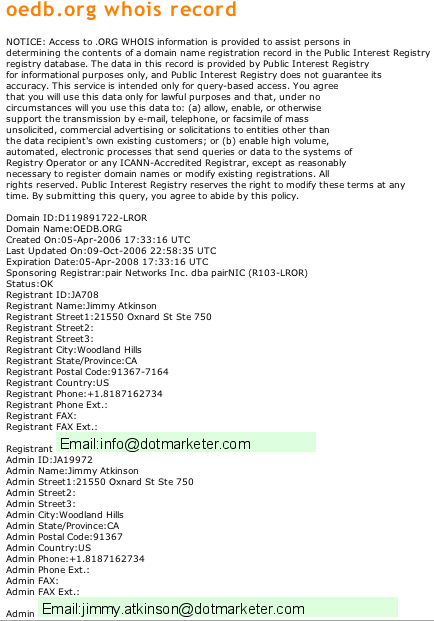
Now off to easywhois.com; I entered the domain: oedb.org. The results:


I zeroed in on:


Created On:05-Apr-2006 17:33:16 UTC
Last Updated On:09-Oct-2006 22:58:35 UTC
Expiration Date:05-Apr-2008 17:33:16 UTC


as well as the Registrant Name, City, State, Country and the email addresses.


Next a Google search for "Jimmy Atkinson." Some self promotion sites but there could be more than one Jimmy Atkinson in the world. The sixth hit was to the Six Sigma Blog which also appeared on a list of sites sourced back to dotmarketer.com. The fourth and fifth hit were to a recent Stephen Downes post at OLDaily where he gives a positive but reserved review of a "post" by Jimmy Atkinson at OEDb called Hacking Knowledge: 77 Ways to Learn Faster, Deeper, and Better. (I only skimmed the article but it did catch my interest and I plan to go back and read it sometime next week.)


Last stop on this tour was to the Internet Archive to use the Wayback Machine (I searched for http://oedb.org). This showed the url http://oedb.org first went live in August of 2000. It was about the Oahu Economic Development Board (OEDB) in Hawaii. In July of 2002 the site undergoes a major redesign and name change to Enterprise Honolulu which is still active at http://www.enterprisehonolulu.com. The next major change is when the domain switches ownership and becomes the Outdoor Education Database (OEDB) on August 6, 2004. The last record of the domain is April 28, 2005. It is still the url for the Outdoor Education Database. From what I learned above it looks like Jimmy acquired the domain for the Online Education Database (OEDb) in April of this year and went public with it three months ago, in September.


I looked at the top 100 list of education blogs. There are a lot of folks I know there. It's a pretty good list although I'm glad I didn't write it. I really wouldn't know where to begin, or end, such a list.


Jimmy seems to like my blog. I'm gratified that he feels my work belongs in his top 100; but is it "big news" that A Difference has made this Top 100 list? Well, no, not really. It looks like it's just one person's opinion. The site and email made it look like it was a significant accomplishment. I think the Eddies were a much bigger deal.


Why would Jimmy do this? Go to all the trouble to find, organize and link to 100 different edublogs? That's a lot of work! He might just be trying to generate some traffic on his site or he might just want to share his personal favourites list. Either way, there's some opacity here that should be made transparent.


I hope my students are reading this.

The Recognition of Your Peers

Yesterday morning (in Winnipeg) EdTechTalk hosted the awards ceremonies for the 2006 EduBlog Awards. K12 Online 2006 won in the category of Best Post, Resource or Presentation. Sheryl, Wes and I have said to each other many times: "This is really a win for the broad cross section of the edublogging community that came together to make it such a success." -- Congratulations, and thank you.


I neglected to mention one person who worked tirelessly and quietly behind the scenes. Without her poise, charm, sensitivity and class, K12 Online would have been less than it was: Lani Ritter-Hall. Thanks Lani, this is as much your win as anyone else's; both as a presenter and a volunteer who gave unselfishly of your time and energy for the benefit of us all.


On another note I just finished reading Graham Wegner's reflection of the results of this year's Eddies. He's got mixed feelings after looking through the stats published on the Awards site.


Personally, I don't attach too much significance to these stats. The percentages would be a little more interesting if we also knew the total number of votes cast, but even then, I don't think it would be terribly relevant. The fact of a blog's nomination is the most significant datum here.


In order to be nominated your site must be blindly and consistently chosen by many different people as one of the best in a category. One email address, one nomination per category (I think). For me, the whole exercise could be concluded when the nominees are announced. The annual list of nominees is a significant contribution to my personal learning network.


The voting process is such that one person can vote many, many times as long as they do so from different computers. (How many computer labs are in your school?) As a matter of fact, a knowledgeable computer user could vote many times from the same computer. (What do you know about "cookies?")


Now it's possible that someone might use many different email addresses to skew the nominations in their favour but given the amount of time and effort required to do that I think it unlikely. The ease with which one person can cast multiple votes makes that a far more likely practice.


Are people actually doing these things? I don't know. And I don't really care. Look, it's nice to win. I would have been happy to win in my category but that I didn't doesn't really bother me. In my view, the fact of my nomination carries far greater significance. I think the same is true for all the nominees. I wish nothing but the best to all the winners ... and congratulations to everyone who was nominated! You've earned the recognition of your peers. Peers who really understand what it is you've been doing. Bravo!


The winners and nominees are, or rather, my reading list for next little while is:


Best Audio and/or Visual Blog


absolutely intercultural! Anne Fox (Denmark), Laurent Borgmann (Germany)


Best Group Blog:


Polar Science 2006 YES I Can! Science team, McMaster University in Hamilton, Ontario, Canada Diane Hammond, Susan Stiff, and Dr. Tom Stiff (Canada)


Best Individual Blog:


Christopher D. Sessums :: Blog Christopher D. Sessums (USA)


Most Influential Post, Resource or Presentation:


K12 Online Conference 2006 Darren Kuropatwa (Canada), Sheryl Nussbaum-Beach (USA), Wes Fryer (USA)


Best Library/ Librarian Blog:


Hey Jude Judy O’Connell (Australia)


Best Newcomer: (joint winners)


Ed Tech Journeys Pete Reilly (USA)


tilt! Paz Peña (Chile)


Best Research Paper:


Nancy White: Blogs and Community Nancy White (USA)


Best Teacher Blog:


Have Fun with English! 2 Teresa Almeida d’Eça (Portugal)


Best Undergraduate Blog:


CILASS Student Blog University of Sheffield Student Ambassadors of the Centre for Inquiry-based Learning In the Arts and Social Sciences (England)


Best Wiki:


Flat Classroom Project Vicki Davis (USA), Julie Lindsay (Bangladesh)


Edublog Star Award (Convenors choice):


Duck Diaries Barbara Cohen (USA)