The Global Learners Workshops

I just stumbled upon these videos on google video. They are from a 2 day series of workshops I did last summer for the Global Learners of Adams County School District #14 in Commerce City, Colorado. I knew that Joe Miller had recorded my presentations, I've only just now discovered them. Thanks for sharing this Joe!


While some of my thinking and the assignments I give my students have evolved since then, it's still a pretty good overview of how I work with my students and how I think about designing learning experiences and assessments for them. Each video is about an hour long.


Part 1 of 5: Tear Down The Walls (Day 1, August 9, 2007)


Part 2 of 5: Learning The Guitar (Day 1, August 9, 2007)


Part 3 of 5: Whiplash! (Day 1, August 9, 2007)


Part 4 of 5: What Can I Do Now That I Couldn't Do Before? (Day 2, August 10, 2007)


Part 5 of 5: Developing Expert Voices (Day 2, August 10, 2007)


The Buzz Was About Pedagogy

I was at Alan November's Building Learning Communities conference in Boston from July 15 to 18. This was the third year I was there and it was the best yet because the buzz was different.


Last year I left the conference hearing everyone saying things like:


» I have to learn flickr


» I have to learn wikis


» I have to learn blogs


» I have to learn [insert social media tool du jour]


This year the buzz was much more about pedagogy. The talk in the halls sounded like:


» I can use [this] to teach [that]


» I can see how much easier it would be for my students to understand if I used ...


» My students are going to LOVE learning this way!


I hope that sentiment was captured in the last minute reflection a number of us did together shared via Ustream:


Live Streaming by Ustream.TV


I captured some of the Ustream chat here.


Of course the best part of any conference is the people. I reconnected with old friends, met several "old friends" face to face for the first time, and met some people for the first time. Together, they made the conference feel like going to summer camp. ;-)


The three Keynote presenters (Ewan Mcintosh, John Davitt, and Dr. Pedro Noguera gave talks that dovetailed nicely together with a very strong focus on teaching and learning. They hadn't planned it that way but it seemed as though the three of them had collaborated to deliver a unified message. (If you want to listen to their talks Bob Sprankle has some of the best BLC08 coverage on the net over on his blog.)


I gave three presentations. One was an update from another I gave last year (What Can I Do Now That I Couldn't Do Before), the second (A Day In The Life) was a major revamp of one I did for Alec Couros' and Dean Shareski's graduate classes earlier this year. I worked hard to refine the ideas and practices I was sharing and tie them much more tightly to research on teaching and learning. The third (Everything New is Old Again: living and teaching in accelerating times) Clarence and I did together. This was the first time we had ever presented collaboratively. (This particular collaboration involved skype, google presentations, flickr, and Starbucks; a story unto itself really. ;-))


Mobile phones appear to be coming into their own as a learning tool this year. I tried something different using the photo capabilities of participants' mobiles and flickr. While in session I shared my private "publish directly to my flickr account" email address. I asked everyone to take pictures with their phones and email to the address I gave them (I've since changed the address). My account was set up to tag the photos automatically BLC08. Meanwhile, I had a wiki where I archived all my presentation resources. On a page in the wiki I embedded a slideshow I had created using Slideflickr. Slideflickr allows you to link music located somewhere online to play automatically while the slides are playing. I used Skreemr.com and Jamendo to find the music I linked to the slideshows -- I did this activity in two sessions.


All my BLC stuff is archived on the wiki I made for the conference. For those of you that don't feel like clicking through I've embedded the slides here:


Learning To Swim

Several months ago Melissa Hartman asked me if I'd write an article about social networking in the lives of teenagers for Imagine Magazine. It's a non-profit out of Johns Hopkins Center for Talented Youth; she's the editor.


I learned a lot about writing and working with an editor. It turned into more of an article about digital ethics than social networking. When I started I thought: 650 words! How am I going to write that much? Over 2000 words later (about three articles worth) I thought: 650 words! How am I ever going to get it down to so few? In the end I submitted about 750 words and the editing process began. I learned how to balance style, content, and story. I learned how to edit myself ruthlessly. I learned how it feels when someone else edits me ruthlessly. And I learned how easy it is to find a happy medium when you're working with a good editor.


This is the article that made it into print, the May/June 2008 issue titled Art Now (one of the two buttons in the top right corner of the window below will allow you to enlarge the image to make it easier to read):


Read this document on Scribd: Darren Kuropatwa: Learning To Swim


What do you think? Would this appeal to your average middle school student? (12 to 14 years old)

Student Voices: Episode 5 Ben and Mark


In this final episode of Student Voices for the 2007-2008 school year, two students, one grade 12 (17 years old) one grade 11 (16 years old), discuss how they evolved their innovative study practices that lead to them doing better on their final provincial standards test than they had done in their class work during the winter semester of 2008. They used a mash up of various online tools and reveal how they unwittingly became mentors for the rest of their class.


I had no idea they were doing this all semester. You'll hear the surprise in my voice. The best part of it comes at the end where the boys, one graduating one taking AP Calculus with me in September, talk about how they will mentor my future classes using the style they developed. What a great way to end the school year!


Let us know what you thought about the the ideas in podcast by leaving a comment.


(Download File 7.9Mb, 16 min. 30 sec.)


Show Notes


    » Pre-Cal 40S (Winter 2008) class blog


    » LaTeX Equation Editor

(I just found this! We'll be using it in class next year.)


    » Manitoba Provincial Exams Archive


    » Math 40S.com


Photo Credit: Shadow singer by flickr user EugeniusD80

Student Voices Episode 4: Justice, Lawrence, and Richard


First an update on this podcast: While we have received few comments on this or any of our class blogs the number of times the audio files have been downloaded is remarkable ...


Episode 1: Jessie 2440 downloads


Episode 2: Tim_MATH_y 1766 downloads


Episode 3: Chris, Craig, Graeme 1367 downloads


Thanks to all our listeners. We might get one more published during this school year but this may be the last until September. In any case feel free to let me or my students know your thoughts about what they had to say; every comment is appreciated. As their teacher, I'm awfully proud of them. I can only imagine how their parents must feel.


In this episode of Student Voices three Pre-Calculus students talk about how they put together their Developing Expert Voices project and what they learned in the process: how they they best learn math, how it can best be taught, and many other incidental things like team work and organizational skills.


All three of these students are in Grade 11 (about 16 years old). They are taking their grade 12 math course this year so that they can take AP Calculus next year.


They have titled their project with one of my favourite reminders to all my students: Mathematics is the Science of Patterns. If you watch any of the video content they created you'll hear several "in jokes". I'll let you "in" on a few of them:


• I eat a lot of yogourt. Between 1/2 and 3/4 of a litre most days.


• I HATE when students come late to class.


• I tell lots of stories in class; always with a mathematical slant or moral.


• To encourage students to move quickly I often say: "Hupsha, hupsha, quick like a bunny!"


• When students ask permission to miss my class to attend other school related events I almost always ask: "What?!? You want to miss my honey dripping words of wisdom?"


• You can see some more of my "famous expressions" here.


Let Justice, Lawrence, and Richard know what you thought about the podcast by leaving a comment here on this post or on the mirror of this post on their class blog.


Without any further ado, here is the podcast. A copy of the poster they made for their work is below.


(Download File 12.2Mb, 25 min. 30 sec.)


Photo Credit: Shadow singer by flickr user EugeniusD80

Les Foltos: Brainstorm and Wrap Up


This is the closing keynote presentation given by Les Foltos, Director of the Puget Sound Center for Teacher Learning and Technology, at the Microsoft Innovative Educators Conference held in Winnipeg on May 29, 2008. (The site appears to be down, or broken, now. I thought it was supposed to serve as a commons around which a growing network of teachers was going to built. I wonder what happened?)


This is the last podcast from the from the conference I recorded. It's a little noisy to listen to. We were all talking in small groups trying to crystallize what we had learned over the previous two days. The good news is we talked about many of the same things that we had discussed in the previous day's Ustream. The voices you hear talking in our little group are me, Clarence Fisher, Chris Harbeck, John Evans, Andy McKiel, Kathy Cassidy, and another lady whose name, unfortunately, I've forgotten. She was sitting in a neighbouring group and kept looking over at us, interested in what we were talking about. So, I invited her over and I'm glad she joined us. I think we all got a lot out of this conversation. Give it a listen and add your own two cents in the comments below.


(Download File 30.0Mb, 62 min. 30 sec.)


UPDATE


Great news! Chris found the Ustream recording!! Good on ya Chris. ;-)


Watcher beware: a surprising amount of time is devoted to discussing Dean Shareski's eating habits and his coffee mug — we had a lot of laughs. ;-)


Time: 36 min. 13 sec.


Live Videos provided by Ustream.TV

Richard Van Eck: Games Based Learning Breakout Session


This is the audio from Richard Van Eck's breakout session at the Microsoft Innovative Educators Conference. It's full of very practical ideas for how to incorporate using commercial off-the-shelf (COTS) games in teaching a variety of subjects in the K-12 curriculum. Rick's presentations are very grounded with very little flash in his slides but lots of good concrete ideas to take back to the classroom. The night before this session Rick gave a keynote presentation on games based learning. He was asked if the kind of learning kids do in games based learning transfers well to the content areas. He looked the questioner straight in the eye and said, loudly and clearly: No. Then he fleshed out that answer. I still might be able to track down the audio from the keynote. If I can get it I'll publish it here. In the mean time this is a very practical talk about how to begin using COTS games in your classroom.


At about 19 minutes in Rick tried to get online but was locked out. Thankfully, Chris Harbeck was there and had the password. ;-)


(Download File 14.6Mb, 30 min. 30 sec.)


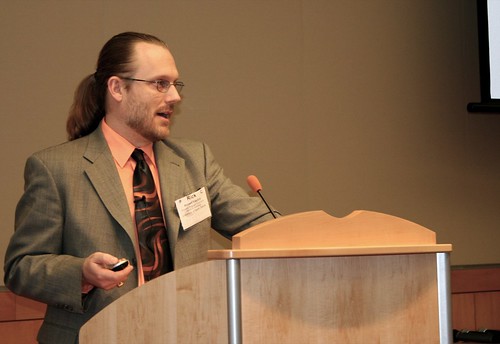
Photo Credit: Richard Van Eck by flickr user cogdog